Beauty & personal care
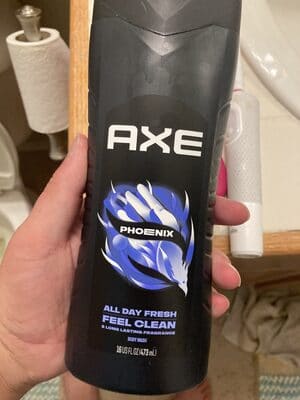
Axe (Phoenix: Crushed Mint And Rosemary Sent) Bodywash
Score
- Contains fragrance
- Contains sulfate surfactants
- May contain traces of 1,4-dioxane
Why it scores 90
Axe (Phoenix: Crushed Mint And Rosemary Sent) Bodywash scores 90 out of 100 (Excellent) under GoodSwap’s published rules. What moved the score most:
- minus 5 points Fragrance (parfum): A single label term covers an undisclosed mixture. Regulatory
- minus 1 points Sodium laureth sulfate (SLES): Ethoxylated ingredients can contain trace 1,4-dioxane, a manufacturing by-product (IARC Group 2B). Strong
- minus 1 points Cocamidopropyl betaine: Rare contact allergy has been traced to manufacturing impurities (dimethylaminopropylamine, cocamidopropyl dimethylamine). Strong
Every line of the math is on The Receipt below, with its evidence tier and sources.
Better deodorant
-
 Supernatural All Body Deodorant Hume No fragrance · No sulfate surfactants Score 100 out of 100 , 10 points higher
 -
 Aquaphor ointment body spray Aquaphor · 3.7 oz 105 g No fragrance · No sulfate surfactants Score 100 out of 100 , 10 points higher
The same kind of product, at least 10 points higher, sold in the US. Never paid placements.
The Receipt
Axe (Phoenix: Crushed Mint And Rosemary Sent) Bodywash
Ingredients
- Fragrance (parfum) minus 5 points
- Sodium laureth sulfate (SLES) minus 1 points
- Cocamidopropyl betaine minus 1 points
- Sodium benzoate (cosmetic) minus 0.5 points
- Polyethylene glycols (PEG) and ethoxylates minus 0.5 points
- Benzyl salicylate minus 0.5 points
- Limonene minus 0.5 points
- Linalool minus 0.5 points
- Blue 1 (CI 42090) minus 0.5 points
- Red 33 (CI 17200) minus 0.5 points
100 − 10.5 = 89.5 → 90
Ingredients
- Water
- Sodium c12-13 Pareth Sulfate
- Glycerin
- Cocamidopropyl Betaine
- Fragrance (moderate concern)
- Sodium Chloride
- Sodium Benzoate
- Citric Acid
- Lactic Acid
- Tetrasodium Edta
- PPG-9
- Saccharide Isomerate
- Benzyl Salicylate
- Limonene
- Linalool
- Blue 1 (CI 42090)
- Red 33 (CI 17200)
Label text, as published
Water, Sodium c12-13 Pareth Sulfate, Glycerin, Cocamidopropyl Betaine, Fragrance, Sodium Chloride, Sodium Benzoate, Citric Acid, Lactic Acid, Tetrasodium Edta, PPG-9, Saccharide Isomerate, Benzyl Salicylate, Limonene, Linalool, Blue 1 (CI 42090), Red 33 (CI 17200)
Allergens and diets
- Palm-oil-free
Always check the package: recipes change.
Sources
-
“when their concentration exceeds 0,001 % in leave-on products and 0,01 % in rinse-off products.”
eur-lex.europa.eu
-
Regulation (EC) No 1223/2009 of 30 November 2009 on cosmetic products
“cosmetic products shall not contain any of the following: (a) prohibited substances — prohibited substances listed in Annex II”
eur-lex.europa.eu
-
fda.gov
-
1,4-Dioxane in Cosmetics: A Manufacturing Byproduct
“1,4-dioxane forms as a byproduct during the manufacturing process of certain cosmetic ingredients.”
fda.gov
-
Agents Classified by the IARC Monographs, Volumes 1–142 (List of Classifications)
monographs.iarc.who.int
-
Occupational contact allergy to cocamidopropyl betaine and its impurities
“Contact allergy to cocamidopropyl betaine has been attributed to its impurities dimethylaminopropylamine and cocamidopropyl dimethylamine.”
doi.org