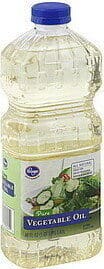
Vegetable oils
Kroger Pure Vegetable Oil
Score
- Contains emulsifiers studied for gut effects
- Contains seed oils
- Contains palm oil
Why it scores 90
Kroger Pure Vegetable Oil scores 90 out of 100 (Excellent) under GoodSwap’s published rules. What moved the score most:
- minus 2.5 points Soybean oil: High in omega-6 linoleic acid. Emerging
- minus 2.5 points Hydrogenated oil: An ingredient typical of ultra-processed foods (NOVA group 4). Info
- minus 2.5 points Palm oil: About half saturated fat; WHO recommends keeping saturated fat to 10% of energy or less. Strong
Every line of the math is on The Receipt below, with its evidence tier and sources.
The Receipt
Pure Vegetable Oil
Ingredients
- Soybean oil minus 2.5 points
- Hydrogenated oil minus 2.5 points
- Palm oil minus 2.5 points
- Mono- and diglycerides minus 1.5 points
- TBHQ (tert-butylhydroquinone) minus 1.5 points
100 − 10.5 = 89.5 → 90
Nutrition per 100 g
| Energy | 110 kcal |
|---|---|
| Fat | 12 g |
| Saturated fat | 3.5 g |
| Trans fat | 0 g |
| Carbohydrates | 0 g |
| Sugars | 0 g |
| Protein | 0 g |
| Salt | 0 g |
Serving: 1 Tbsp (14 g)
Ingredients
- Soybean Oil
- Fully Hydrogenated Palm Oil
- Palm Oil
- Mono and Diglycerides
- TBHQ and Citric Acid ( Antioxidants)
Label text, as published
Soybean Oil, Fully Hydrogenated Palm Oil, Palm Oil, Mono and Diglycerides, TBHQ and Citric Acid ( Antioxidants).
Allergens and diets
Contains: Soy
- Vegan
- Vegetarian
- Not palm-oil-free
Always check the package: recipes change.
Packaging
Pet 1 polyethylene terephthalate
Context only: no points in v1.
More vegetable oils on GoodSwap
-
 No-Stick Cooking Spray PAM · 340 g Ultra-processedContains seed oilsContains palm oil Score 75 out of 100 Good
 -
 I can't believe It's not Butter! the ORIGINAL I Can'T Believe It's Not Butter · 8 oz (226 g) Ultra-processedContains seed oilsContains artificial flavorsMay contain traces of 1,4-dioxane Score 64 out of 100 Good
 -
 Cooking spray PAM · 8 oz Ultra-processedContains seed oilsContains palm oil Score 75 out of 100 Good
 -
 Pure vegetable oil Aldi Contains seed oilsNo additives Score 100 out of 100 Excellent
 -
 Avocado Oil Louana · 16 fl oz No additivesSeed-oil free Score 100 out of 100 Excellent
 -
 Sesame Oil Kikkoman · 5 oz No additivesSeed-oil free Score 100 out of 100 Excellent
More from Kroger


Sources
-
“replacement of saturated fat in the diet with linoleic acid effectively lowers serum cholesterol but does not support the hypothesis that this translates to a lower risk of death from coronary heart disease or all causes.”
doi.org
-
“These data provide support for current recommendations to replace saturated fat with polyunsaturated fat for primary prevention of CHD.”
doi.org
-
Saturated fatty acid and trans-fatty acid intake for adults and children: WHO guideline
“WHO recommends that adults and children reduce saturated fatty acid intake to 10% of total energy intake (strong recommendation).”
who.int
-
Process contaminants in vegetable oils and foods
“The highest levels of GE, as well as 3-MCPD and 2-MCPD (including esters) were found in palm oils and palm fats, followed by other oils and fats.”
efsa.europa.eu
-
“Glycidyl fatty acid esters, expressed as glycidol”
eur-lex.europa.eu
-
“This study found positive associations between risk of CVD and intake of five individual and two groups of food additive emulsifiers widely used in industrial foods.”
doi.org
-
Re-evaluation of mono- and di-glycerides of fatty acids (E 471) as food additives
“The available studies did not raise any concern with regard to genotoxicity.”
doi.org
-
“E 127 Erythrosine 200 only cocktail cherries and candied cherries”
eur-lex.europa.eu
-
11. List of Permitted Preservatives (Lists of Permitted Food Additives)
“B.2 Butylated Hydroxyanisole n/a (a) Active dry yeasts (a) Preservative (a) 1,000 ppm n/a”
canada.ca
-
Dietary emulsifiers impact the mouse gut microbiota promoting colitis and metabolic syndrome
“carboxymethylcellulose and polysorbate-80, induced low-grade inflammation and obesity/metabolic syndrome in wild-type hosts and promoted robust colitis in mice predisposed to this disorder.”
doi.org
-
“Relative to control subjects, CMC consumption modestly increased postprandial abdominal discomfort and perturbed gut microbiota composition in a way that reduced its diversity.”
doi.org