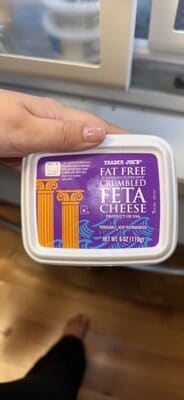
Feta
Trader Joe's Fat Free Crumbled Feta Cheese
6 oz
Score
- Ultra-processed
- High in salt
Why it scores 68
Trader Joe's Fat Free Crumbled Feta Cheese scores 68 out of 100 (Good) under GoodSwap’s published rules. What moved the score most:
- minus 18 points Ultra-processed (NOVA 4): Classified NOVA 4: made with industrial ingredients and additives. Strong
- minus 9 points Salt 2.4 g / 100 g: Very high in salt. Strong
- plus 4 points Protein 21.4 g / 100 g: A good source of protein. Info
Every line of the math is on The Receipt below, with its evidence tier and sources.
Better cheese
-
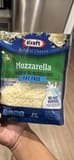 Mozzarella Shredded Fat Free Mozzarella Cheese Kraft Not ultra-processed · Less salt Score 92 out of 100 , 24 points higher
 -
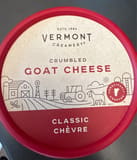 Crumbled Goat Cheese Classic Chèvre Vermont Creamery Not ultra-processed · Less salt Score 91 out of 100 , 23 points higher
 -
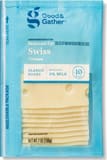 Swiss Classic Reduced Fat Cheese Good & Gather · 7 oz Not ultra-processed · Less salt Score 91 out of 100 , 23 points higher
 -
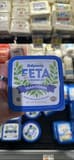 Feta Crumbled Traditional Odyssey · 6 oz Not ultra-processed · Less salt Score 86 out of 100 , 18 points higher
 -
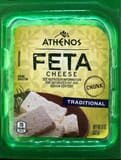 Feta Cheese Chunk Traditional Athenos Not ultra-processed · Less salt Score 88 out of 100 , 20 points higher
The same kind of product, at least 10 points higher, sold in the US. Never paid placements.
The Receipt
Fat Free Crumbled Feta Cheese
Ingredients
- Whey protein concentrate / isolate minus 2.5 points
- Powdered cellulose minus 2.5 points
- Natamycin minus 2.5 points
Processing
- Ultra-processed (NOVA 4) minus 18 points
- 2 kinds of ultra-processing markers minus 1.5 points
Nutrition per 100 g
- Salt 2.4 g / 100 g minus 9 points
- Protein 21.4 g / 100 g plus 4 points
100 − 32 = 68
Can’t score above 79. High in salt (above the front-of-pack "high" level). [5]
Nutrition per 100 g
| Energy | 125 kcal |
|---|---|
| Fat | 0 g |
| Saturated fat | 0 g |
| Trans fat | 0 g |
| Carbohydrates | 10.7 g |
| Sugars | 0 g |
| Added sugars | 0 g |
| Fiber | 0 g |
| Protein | 21.4 g |
| Salt | 2.4 g |
Serving: 28g
Ingredients
- FAT FREE FETA CHEESE (PASTEURIZED SKIM MILK, WHEY PROTEIN CONCENTRATE, SALT, CHEESE CULTURES, MICROBIAL ENZYMES)
- CELLULOSE POWDER (ANTI-CAKING AGENT)
- NATAMYCIN (MOLD INHIBITOR)
Label text, as published
FAT FREE FETA CHEESE (PASTEURIZED SKIM MILK, WHEY PROTEIN CONCENTRATE, SALT, CHEESE CULTURES, MICROBIAL ENZYMES), CELLULOSE POWDER (ANTI-CAKING AGENT), NATAMYCIN (MOLD INHIBITOR)
Allergens and diets
Contains: Milk
- Not vegan
- Palm-oil-free
Always check the package: recipes change.
More feta on GoodSwap
-
 Feta Crumbles President · 24 oz Ultra-processedHigh in saltHigh in saturated fat Score 67 out of 100 Good
 -
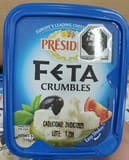 Feta Crumbles President · 6 oz Ultra-processed Score 75 out of 100 Good
 -
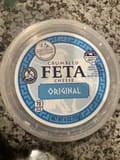 Crumbled Feta Cheese Original Emporium Selection · 4 oz High in saltHigh in saturated fat Score 79 out of 100 Good
 -
 Feta Crumbles President · 12 oz Ultra-processedHigh in saltHigh in saturated fat Score 69 out of 100 Good
 -
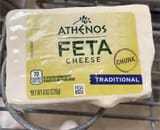 Feta cheese chunk Athenos · 8 oz High in saltHigh in saturated fat Score 79 out of 100 Good
More from Trader Joe's
Sources
-
11. List of Permitted Preservatives (Lists of Permitted Food Additives)
“B.2 Butylated Hydroxyanisole n/a (a) Active dry yeasts (a) Preservative (a) 1,000 ppm n/a”
canada.ca
-
“For adults, WHO recommends less than 2000 mg/day of sodium (equivalent to less than 5 g/day salt), or just under a teaspoon.”
who.int
-
Dietary Guidelines for Americans, 2025–2030
“Limit foods and beverages that include artificial flavors, petroleum-based dyes, artificial preservatives, and low-calorie non-nutritive sweeteners.”
cdn.realfood.gov
-
“Table 3: Criteria for drinks (per 100ml)”
assets.publishing.service.gov.uk
-
“Greater exposure to ultra-processed food was associated with a higher risk of adverse health outcomes, especially cardiometabolic, common mental disorder, and mortality outcomes.”
doi.org