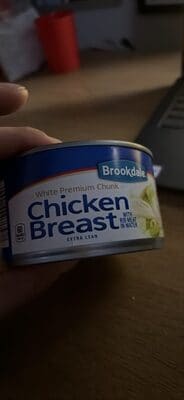
Chicken breasts
Brookdale Chicken Breast with Rib Meat in Water
Score
- Ultra-processed
Why it scores 78
Brookdale Chicken Breast with Rib Meat in Water scores 78 out of 100 (Good) under GoodSwap’s published rules. What moved the score most:
- minus 18 points Ultra-processed (NOVA 4): Classified NOVA 4: made with industrial ingredients and additives. Strong
- plus 4 points Protein 19.6 g / 100 g: A good source of protein. Info
- minus 3 points Salt 1 g / 100 g: High in salt. Strong
Every line of the math is on The Receipt below, with its evidence tier and sources.
Better canned chicken and meats
-
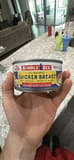 Chicken Breast with Rib Meat - Chunk in Water Bumble Bee · 10 oz Not ultra-processed · No modified starch Score 96 out of 100 , 18 points higher
 -
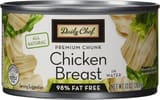 All natural chicken breast in water Daily Chef Not ultra-processed · No modified starch Score 100 out of 100 , 22 points higher
 -
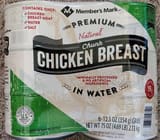 Natural Chunk Chicken Breast in Water Member's Mark · 75 oz Not ultra-processed · No modified starch Score 96 out of 100 , 18 points higher
 -
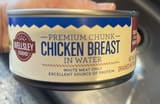 Premium Chunk Chicken Breast in Water Wellsley Farms · 40 oz/2.5 lb/1.31 kg Not ultra-processed · No modified starch Score 96 out of 100 , 18 points higher
 -
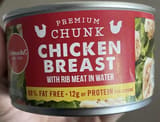 Premium chunk white chicken breast in water Schnucks · 12.5 oz/354 g Not ultra-processed · No modified starch Score 96 out of 100 , 18 points higher
The same kind of product, at least 10 points higher, sold in the US. Never paid placements.
The Receipt
Chicken Breast with Rib Meat in Water
Ingredients
- Modified starch minus 2.5 points
- Sodium phosphate minus 2.5 points
Processing
- Ultra-processed (NOVA 4) minus 18 points
Nutrition per 100 g
- Salt 1 g / 100 g minus 3 points
- Protein 19.6 g / 100 g plus 4 points
100 − 22 = 78
Nutrition per 100 g
| Energy | 107 kcal |
|---|---|
| Fat | 1.8 g |
| Saturated fat | 0 g |
| Trans fat | 0 g |
| Carbohydrates | 1.8 g |
| Sugars | 0 g |
| Added sugars | 0 g |
| Fiber | 0 g |
| Protein | 19.6 g |
| Salt | 1 g |
Serving: 1 serving (56 g)
Ingredients
Label text, as published
cooked chicken breast with rib meat, water, contains less than 2% of the following: modified food starch, salt, sodium phosphates,
Allergens and diets
- Not vegan
- Not vegetarian
- Palm-oil-free
Always check the package: recipes change.
More chicken breasts on GoodSwap
-
 Chunk Chicken Breast Costco Companies Inc. · 354 g Ultra-processed Score 81 out of 100 Excellent
 -
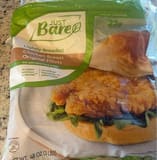 Chicken Breast Fillets Just Bare High in saltContains added sugarsContains seed oils Score 64 out of 100 Good
 -
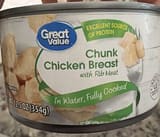 Chunk Chicken Breast with Rib Meat Great Value · 354 g Ultra-processed Score 72 out of 100 Good
 -
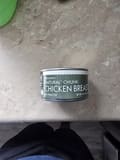 Premium Natural* Chunk Chicken Breast in Water Member's Mark · 354 g No additives Score 93 out of 100 Excellent
 -
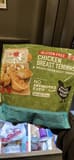 Chicken Breast Tenders Breaded Chicken Breast Fillets Applegate Naturals · 16 oz Contains added sugarsContains seed oilsNo synthetic dyes Score 68 out of 100 Good
 -
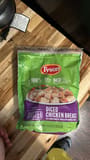 Oven Roasted Diced Chicken Breast Tyson · 22 oz Ultra-processedHigh in saltContains added sugarsContains seed oils Score 25 out of 100 Poor
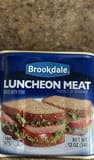
More from Brookdale
Sources
-
EFSA issues new advice on phosphates
“We estimated that dietary exposure to phosphates may exceed the new ADI for infants, toddlers and children with average consumption of phosphates in their diet.”
efsa.europa.eu
-
“For adults, WHO recommends less than 2000 mg/day of sodium (equivalent to less than 5 g/day salt), or just under a teaspoon.”
who.int
-
Dietary Guidelines for Americans, 2025–2030
“Limit foods and beverages that include artificial flavors, petroleum-based dyes, artificial preservatives, and low-calorie non-nutritive sweeteners.”
cdn.realfood.gov
-
“Greater exposure to ultra-processed food was associated with a higher risk of adverse health outcomes, especially cardiometabolic, common mental disorder, and mortality outcomes.”
doi.org