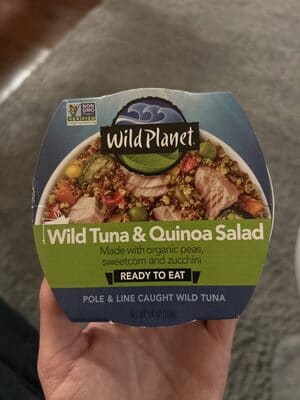
Tuna salads
Wild Planet Wild tuna quina salad
5.6 oz/160 g
Score
- Contains seed oils
- Certified organic
- No additives
- Contains whole grains
Why it scores 100
Wild Planet Wild tuna quina salad scores 100 out of 100 (Excellent) under GoodSwap’s published rules. What moved the score most:
- plus 5 points Certified organic: Carries a certified-organic label. Info
- minus 3 points Saturated fat 2.5 g / 100 g: High in saturated fat. Strong
- minus 3 points Salt 1.2 g / 100 g: High in salt. Strong
Every line of the math is on The Receipt below, with its evidence tier and sources.
The Receipt
Wild tuna quina salad
Ingredients
- Sunflower oil minus 2.5 points
Nutrition per 100 g
- Saturated fat 2.5 g / 100 g minus 3 points
- Salt 1.2 g / 100 g minus 3 points
- Energy 188 kcal / 100 g minus 1 points
- Protein 9.4 g / 100 g plus 2 points
Bonuses
- Certified organic plus 5 points
- No additives plus 3 points
100 + 0.5 = 100.5 → 100
Nutrition per 100 g
| Energy | 188 kcal |
|---|---|
| Fat | 12.5 g |
| Saturated fat | 2.5 g |
| Trans fat | 0 g |
| Carbohydrates | 11.3 g |
| Sugars | 1.9 g |
| Added sugars | 0 g |
| Fiber | 2.5 g |
| Protein | 9.4 g |
| Salt | 1.2 g |
Serving: 1 can (160 g)
Ingredients
- SKIPJACK TUNA (KATSUWONUS PELAMIS)
- QUINOA
- SUNFLOWER OIL
- RED PEPPER
- YELLOW PEPPER
- CARROT
- ZUCCHINI
- PEAS
- SWEETCORN
- GREEN OLIVE
- SALT
- GROUND BLACK PEPPER
- CURCUMA (FROM TURMERIC)
Label text, as published
SKIPJACK TUNA (KATSUWONUS PELAMIS), *QUINOA, *SUNFLOWER OIL, *RED PEPPER, *YELLOW PEPPER, *CARROT, *ZUCCHINI, *PEAS, *SWEETCORN, *GREEN OLIVE, SALT, *GROUND BLACK PEPPER, *CURCUMA (FROM TURMERIC). *ORGANIC. CONTAINS FISH (TUNA). PROCESSED IN A FACILITY THAT ALSO PROCESSES WHEAT & EGG. CAN CODE:LE4185H/PRODUCTION DATE:07/03/2024 BEST BY DATE: 07/03/2027 PRODUCED FOR WILD PLANET FOODS, INC. Certified Organic By CRAEGA MCKINLEYVILLE, CALIFORNIA, 95519 USA. GLOBALLY SOURCED FISH - POLE&LINE VESSELS ONLY. PROCESSED IN SPAIN. Non-BPA lining explained at wildplanetfoods.com/faqs Boudouбuou วอod OWS NON CONSELLO REGULADOR DA AGRICULTURA ECOLÓXICA CRAEGA ES-ECO-022-GA 8 29696 100% RECYCLABLE PACKAGING 00451 8 SENESTE 69 L
Allergens and diets
Contains: Egg, Fish
May contain: Gluten
- Not vegan
- Not vegetarian
- Gluten-free
- Palm-oil-free
Always check the package: recipes change.
More tuna salads on GoodSwap
More from Wild Planet
-
 Albacore Tuna Wild Planet · 5 oz (142 g) Score 97 out of 100 Excellent
 -
 Wild Pacific Sardines Wild Planet · 6/4.4 oz cans (26.4 oz (750 g)) Score 90 out of 100 Excellent
 -
 Skipjack Wild Tuna Wild Planet · 5 oz/142 g Score 100 out of 100 Excellent
 -
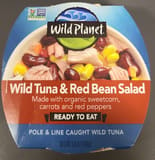 Wild Tuna & Red Bean Salad Wild Planet · 5.6 oz Score 96 out of 100 Excellent
Sources
-
“replacement of saturated fat in the diet with linoleic acid effectively lowers serum cholesterol but does not support the hypothesis that this translates to a lower risk of death from coronary heart disease or all causes.”
doi.org
-
“These data provide support for current recommendations to replace saturated fat with polyunsaturated fat for primary prevention of CHD.”
doi.org
-
Saturated fatty acid and trans-fatty acid intake for adults and children: WHO guideline
“WHO recommends that adults and children reduce saturated fatty acid intake to 10% of total energy intake (strong recommendation).”
who.int
-
“For adults, WHO recommends less than 2000 mg/day of sodium (equivalent to less than 5 g/day salt), or just under a teaspoon.”
who.int
-
Dietary Guidelines for Americans, 2025–2030
“Limit foods and beverages that include artificial flavors, petroleum-based dyes, artificial preservatives, and low-calorie non-nutritive sweeteners.”
cdn.realfood.gov
-
7 CFR 205.102 Use of the term "organic" (National Organic Program)
“Any agricultural product that is sold, labeled, or represented as “100 percent organic,” “organic,” or “made with organic (specified ingredients or food group(s))” must be: (a) Produced in accordance with the requirements specified in § 205.101 or §§ 205.202 through 205.207”
ecfr.gov