Salty snacks
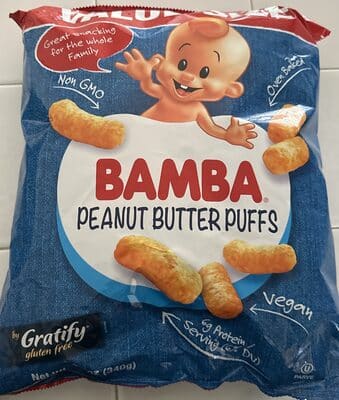
Bamba Peanut Butter Puffs
12 oz/340 g
Score
- Contains seed oils
- No additives
Why it scores 79
Bamba Peanut Butter Puffs scores 79 out of 100 (Good) under GoodSwap’s published rules. What moved the score most:
- minus 5 points Saturated fat 4.4 g / 100 g: High in saturated fat. Strong
- plus 4 points Protein 17.7 g / 100 g: A good source of protein. Info
- minus 3 points Salt 1 g / 100 g: High in salt. Strong
Capped at 79: High in fat (above the front-of-pack "high" level).
Every line of the math is on The Receipt below, with its evidence tier and sources.
The Receipt
Peanut Butter Puffs
Ingredients
- Sunflower oil minus 2.5 points
Nutrition per 100 g
- Saturated fat 4.4 g / 100 g minus 5 points
- Salt 1 g / 100 g minus 3 points
- Energy 529 kcal / 100 g minus 3 points
- Protein 17.7 g / 100 g plus 4 points
100 − 9.5 = 90.5 → 91 → capped at 79
Capped at 79. High in fat (above the front-of-pack "high" level). [8]
Nutrition per 100 g
| Energy | 529 kcal |
|---|---|
| Fat | 29.4 g |
| Saturated fat | 4.4 g |
| Trans fat | 0 g |
| Carbohydrates | 50 g |
| Sugars | 2.9 g |
| Added sugars | 0 g |
| Fiber | 2.9 g |
| Protein | 17.7 g |
| Salt | 1 g |
Serving: 30g
Ingredients
Label text, as published
PEANUT BUTTER (GROUND PEANUTS), CORN GRITS, SUNFLOWER OIL, SALT.
Allergens and diets
Contains: Peanuts
- Vegan
- Vegetarian
- Gluten-free
- Palm-oil-free
Always check the package: recipes change.
More salty snacks on GoodSwap
-
 Lightly Salted Pistachios Wonderful · 30 g High in saturated fatNo additives Score 79 out of 100 Good
 -
 Totopos El Milagro · 453 g Contains seed oils Score 79 out of 100 Good
 -
 Honey and vanilla, flavored nuts, and fruit clusters Member's Mark · 24 oz Ultra-processedHigh in saturated fatContains added sugarsContains seed oils Score 19 out of 100 Bad
 -
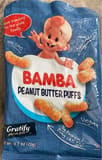 Bamba Peanut Snack Osem · 0.7 oz Contains seed oilsNo additives Score 79 out of 100 Good
 - Cracker Mix Bhuja · 7 oz Ultra-processedContains added sugarsContains seed oils Score 51 out of 100 Okay
-
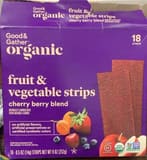 Fruit & vegetable strips Good & Gather · 9 oz Ultra-processedHigh in sugarContains added sugarsCertified organic Score 42 out of 100 Okay
Sources
-
“replacement of saturated fat in the diet with linoleic acid effectively lowers serum cholesterol but does not support the hypothesis that this translates to a lower risk of death from coronary heart disease or all causes.”
doi.org
-
“These data provide support for current recommendations to replace saturated fat with polyunsaturated fat for primary prevention of CHD.”
doi.org
-
Saturated fatty acid and trans-fatty acid intake for adults and children: WHO guideline
“WHO recommends that adults and children reduce saturated fatty acid intake to 10% of total energy intake (strong recommendation).”
who.int
-
“For adults, WHO recommends less than 2000 mg/day of sodium (equivalent to less than 5 g/day salt), or just under a teaspoon.”
who.int
-
Dietary Guidelines for Americans, 2025–2030
“Limit foods and beverages that include artificial flavors, petroleum-based dyes, artificial preservatives, and low-calorie non-nutritive sweeteners.”
cdn.realfood.gov
-
“Table 3: Criteria for drinks (per 100ml)”
assets.publishing.service.gov.uk