Condiments
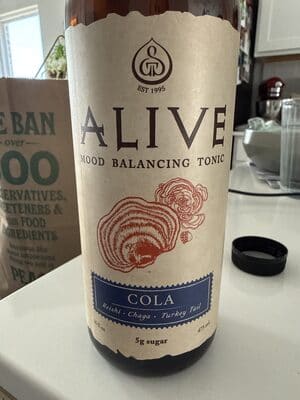
GT’s Living Food Alive Cola
16 fl oz
Score
- Ultra-processed
- Contains non-nutritive sweeteners
- Contains added sugars
- Contains sugar alcohols
- Contains caffeine
Why it scores 51
GT’s Living Food Alive Cola scores 51 out of 100 (Okay) under GoodSwap’s published rules. What moved the score most:
- minus 20 points Sugar: An added sugar. Strong
- minus 18 points Ultra-processed (NOVA 4): Classified NOVA 4: made with industrial ingredients and additives. Strong
- minus 7.5 points Erythritol: A 2023 study linked higher blood erythritol to cardiovascular events and found it increased clotting activity; long-term safety studies are warranted. Strong
Every line of the math is on The Receipt below, with its evidence tier and sources.
The Receipt
Alive Cola
Ingredients
- Sugar minus 20 points
- Erythritol minus 7.5 points
- Stevia (steviol glycosides) minus 2.5 points
Processing
- Ultra-processed (NOVA 4) minus 18 points
- 2 kinds of ultra-processing markers minus 1.5 points
100 − 49.5 = 50.5 → 51
Can’t score above 79. Contains sugar, an ingredient of high concern. [1][2][3]
Nutrition per 100 g
| Energy | 4 kcal |
|---|---|
| Fat | 0 g |
| Saturated fat | 0 g |
| Carbohydrates | 3 g |
| Sugars | 1.1 g |
| Added sugars | 0.8 g |
| Fiber | 0 g |
| Protein | 0 g |
| Salt | 0 g |
Serving: 473.0ml
Ingredients
- ADAPTOGENIC MUSHROOM INFUSION (REISHI, CHAGA, TURKEY TAIL)
- BLACK TEA
- APPLE CIDER VINEGAR
- FRESH PRESSED APPLE JUICE
- FRESH PRESSED LIME JUICE
- CINNAMON
- ERYTHRITOL (moderate concern)
- CANE SUGAR (high concern)
- VANILLA EXTRACT
- KOLA NUT
- SEA SALT
- BLACK PEPPER
- STEVIA
- 100% PURE LOVE!!! (not recognized)
- ORGANICALLY PRODUCED (not recognized)
Label text, as published
ADAPTOGENIC MUSHROOM INFUSION (REISHI, CHAGA, TURKEY TAIL), BLACK TEA*, APPLE CIDER VINEGAR*, FRESH PRESSED APPLE JUICE*, FRESH PRESSED LIME JUICE*, CINNAMON*, ERYTHRITOL*, CANE SUGAR*, VANILLA EXTRACT*, KOLA NUT*, SEA SALT*, BLACK PEPPER*, STEVIA*, 100% PURE LOVE!!!, *ORGANICALLY PRODUCED
Allergens and diets
- Not vegan
- Not vegetarian
Always check the package: recipes change.
More condiments on GoodSwap
-
 Original Creole Seasoning Tony Chachere's · 227 g Score 87 out of 100 Excellent
 -
 Baking Powder Clabber Girl · 8.1 oz (230 g) High in salt Score 79 out of 100 Good
 -
 Roasted Beef Base Better Than Bouillon · 8 oz Ultra-processedHigh in saltContains added sugarsContains seed oils Score 8 out of 100 Bad
 -
 BBQ Sauce Hickory Brown Sugar Kinder's · 15.8 oz Ultra-processedHigh in sugarHigh in saltContains added sugars Score 6 out of 100 Bad
 -
 Original seasoning Mrs Dash · 10 oz/283 g Score 100 out of 100 Excellent
 -
 The blend (salt, pepper, garlic) Kinder's · 6.25 oz High in saltContains seed oilsNo additives Score 79 out of 100 Good
Sources
-
Guideline: sugars intake for adults and children
“In both adults and children, WHO recommends reducing the intake of free sugars to less than 10% of total energy intake”
who.int
-
Dietary Guidelines for Americans, 2025–2030
“Limit foods and beverages that include artificial flavors, petroleum-based dyes, artificial preservatives, and low-calorie non-nutritive sweeteners.”
cdn.realfood.gov
-
Added and free sugars should be as low as possible
“Sugar consumption is a known cause of dental caries.”
efsa.europa.eu
-
The artificial sweetener erythritol and cardiovascular event risk
“Our findings reveal that erythritol is both associated with incident MACE risk and fosters enhanced thrombosis. Studies assessing the long-term safety of erythritol are warranted.”
doi.org
-
Re-evaluation of erythritol (E 968) as a food additive (plain language summary)
“In all groups of people, both acute and chronic exposure to erythritol is above the newly set ADI.”
efsa.europa.eu
-
WHO advises not to use non-sugar sweeteners for weight control in newly released guideline
“The recommendation is based on the findings of a systematic review of the available evidence which suggests that use of NSS does not confer any long-term benefit in reducing body fat in adults or children.”
who.int
-
“Greater exposure to ultra-processed food was associated with a higher risk of adverse health outcomes, especially cardiometabolic, common mental disorder, and mortality outcomes.”
doi.org
-
Regulation (EU) No 1169/2011, Annex III point 2.4 (foods with more than 10 % added polyols)
“‘excessive consumption may produce laxative effects’.”
eur-lex.europa.eu
-
Spilling the Beans: How Much Caffeine is Too Much?
“For most adults, the FDA has cited 400 milligrams* a day — that's about two to three 12-fluid-ounce cups of coffee — as an amount not generally associated with negative effects.”
fda.gov
-
Regulation (EU) No 1169/2011, Annex III point 4.1 (beverages with high caffeine content)
“‘High caffeine content. Not recommended for children or pregnant or breast-feeding women’”
eur-lex.europa.eu