Protein powders
Walmart Plant base protein
32 oz
Score
- Contains emulsifiers studied for gut effects
- Contains whole grains
Why it scores 87
Walmart Plant base protein scores 87 out of 100 (Excellent) under GoodSwap’s published rules. What moved the score most:
- minus 5 points Cellulose gum (carboxymethylcellulose): In a small randomized feeding trial, carboxymethylcellulose modestly increased abdominal discomfort and reduced gut microbiota diversity; in mice it promoted low-grade inflammation. Strong
- minus 5 points Carrageenan: In the NutriNet-Santé cohort, higher carrageenan intake was associated with a higher risk of type 2 diabetes; cause and effect is not established. Strong
- minus 1 points Protein blend (unspecified): An ingredient typical of ultra-processed foods (NOVA group 4). Info
Every line of the math is on The Receipt below, with its evidence tier and sources.
The Receipt
Plant base protein
Ingredients
- Cellulose gum (carboxymethylcellulose) minus 5 points
- Carrageenan minus 5 points
- Protein blend (unspecified) minus 1 points
- Pea protein minus 0.5 points
- Maltodextrin minus 0.5 points
- Vegetable gums (unspecified) minus 0.5 points
- Xanthan gum minus 0.5 points
100 − 13 = 87
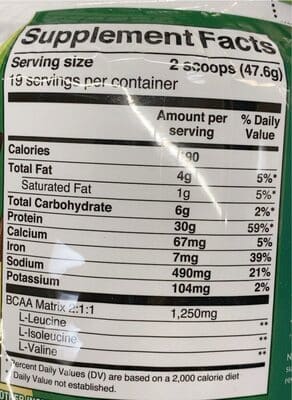
Nutrition per 100 g
| Energy | 404 kcal |
|---|---|
| Fat | 8.5 g |
| Saturated fat | 2.1 g |
| Carbohydrates | 14.9 g |
| Fiber | 2.1 g |
| Protein | 63.8 g |
| Salt | 2.6 g |
Serving: 1 serving (47 g)
Ingredients
- protein blend (pea protein isolate, quinoa)
- maltodextrin
- sea salt
- gum blend (cellulose gum, xanthan gum, carrageenan)
- suppiement facts (not recognized)
Label text, as published
protein blend (pea protein isolate, quinoa) natura flavor, maltodextrin, sea salt, gum blend (cellulose gum, xanthan gum, carrageenan), suppiement facts
More protein powders on GoodSwap
-
 Organic Protein Orgain · 43.2 oz (2.7 lb) 1.22 kg Contains non-nutritive sweetenersContains sugar alcoholsContains seed oilsCertified organic Score 89 out of 100 Excellent
 -
 Organic Protein Orgain · 1.2 kg Contains non-nutritive sweetenersContains sugar alcoholsContains seed oilsCertified organic Score 89 out of 100 Excellent
 -
 Protein powder Optimum Nutrition · 80 × 31 g Contains non-nutritive sweetenersContains emulsifiers studied for gut effectsContains artificial flavors Score 83 out of 100 Excellent
 -
 Vanilla Milkshake Premier Protein · 1370 g Contains non-nutritive sweetenersContains artificial flavors Score 87 out of 100 Excellent
 -
 Clear Low Carb Protein Isopure · 14.1 oz/400 g Contains non-nutritive sweetenersNo synthetic dyes Score 97 out of 100 Excellent
 -
 100% Whey Native Whey Protein Blend Ascent · 32 oz Ultra-processedContains non-nutritive sweeteners Score 72 out of 100 Good
More from Walmart
Sources
-
“Relative to control subjects, CMC consumption modestly increased postprandial abdominal discomfort and perturbed gut microbiota composition in a way that reduced its diversity.”
doi.org
-
Dietary emulsifiers impact the mouse gut microbiota promoting colitis and metabolic syndrome
“carboxymethylcellulose and polysorbate-80, induced low-grade inflammation and obesity/metabolic syndrome in wild-type hosts and promoted robust colitis in mice predisposed to this disorder.”
doi.org
-
“This study found positive associations between risk of CVD and intake of five individual and two groups of food additive emulsifiers widely used in industrial foods.”
doi.org
-
“The Panel concluded that there was no need for a numerical ADI and that there would be no safety concern at the reported uses and use levels for the unmodified and modified celluloses”
doi.org
-
“We found direct associations between the risk of type 2 diabetes and exposures to various food additive emulsifiers widely used in industrial foods, in a large prospective cohort of French adults.”
doi.org
-
Re-evaluation of carrageenan (E 407) and processed Eucheuma seaweed (E 407a) as food additives
“However, the Panel noted uncertainties as regards the chemistry, the exposure assessment and biological and toxicological data.”
doi.org
-
Agents Classified by the IARC Monographs, Volumes 1–142 (List of Classifications)
monographs.iarc.who.int
-
Dietary Guidelines for Americans, 2025–2030
“Limit foods and beverages that include artificial flavors, petroleum-based dyes, artificial preservatives, and low-calorie non-nutritive sweeteners.”
cdn.realfood.gov