Chickens
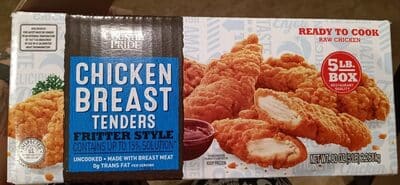
Country Pride Chicken breast tenders
5 lb
Score
- High in salt
- Contains seed oils
Why it scores 77
Country Pride Chicken breast tenders scores 77 out of 100 (Good) under GoodSwap’s published rules. What moved the score most:
- minus 8 points Processed (NOVA 3): Classified NOVA 3: processed with added salt, sugar or oil. Emerging
- minus 7 points Salt 2 g / 100 g: Very high in salt. Strong
- minus 2.5 points Sodium phosphate: EFSA (2019) set a group ADI for phosphates of 40 mg/kg body weight (as phosphorus) and noted that infants, toddlers and children may exceed it. Strong
Every line of the math is on The Receipt below, with its evidence tier and sources.
The Receipt
Chicken breast tenders
Ingredients
- Sodium phosphate minus 2.5 points
- Sodium aluminum phosphate minus 2.5 points
- Soybean oil minus 2.5 points
- Vegetable oil (unspecified) minus 1.5 points
Processing
- Processed (NOVA 3) minus 8 points
Nutrition per 100 g
- Saturated fat 1.8 g / 100 g minus 0.5 points
- Salt 2 g / 100 g minus 7 points
- Energy 241 kcal / 100 g minus 0.5 points
- Protein 15.2 g / 100 g plus 2 points
100 − 23 = 77
Can’t score above 79. High in salt (above the front-of-pack "high" level). [10]
Nutrition per 100 g
| Energy | 241 kcal |
|---|---|
| Fat | 9.8 g |
| Saturated fat | 1.8 g |
| Trans fat | 0 g |
| Carbohydrates | 24.1 g |
| Sugars | 0 g |
| Added sugars | 0 g |
| Fiber | 0.9 g |
| Protein | 15.2 g |
| Salt | 2 g |
Serving: 1 portion (112 g)
Ingredients
- CONTAINS UP TO 15% WATER (not recognized)
- SALT
- SODIUM PHOSPHATES
- BREADED AND BATTERED WITH: WHEAT FLOUR
- WATER
- SALT
- SPICE
- SODIUM ALUMINUM PHOSPHATE
- SODIUM BICARBONATE
- ONION POWDER
- PAPRIKA
- LESS THAN 2% SOYBEAN OIL ADDED AS A PROCESSING AID
- PREDUSTED WITH: WHEAT FLOUR
- BREADING SET IN VEGETABLE OIL
Label text, as published
*CONTAINS UP TO 15% WATER, SALT, SODIUM PHOSPHATES. BREADED AND BATTERED WITH: WHEAT FLOUR, WATER, SALT, SPICE, SODIUM ALUMINUM PHOSPHATE, SODIUM BICARBONATE, ONION POWDER, PAPRIKA, LESS THAN 2% SOYBEAN OIL ADDED AS A PROCESSING AID. PREDUSTED WITH: WHEAT FLOUR. BREADING SET IN VEGETABLE OIL. CONTAINS: WHEAT
Allergens and diets
Contains: Wheat, Gluten
- Not gluten-free
Always check the package: recipes change.
More chickens on GoodSwap
-
 Seasoned Rotisserie Chicken Kirkland Signature · 1360 g (1 chicken) Ultra-processedContains added sugarsContains emulsifiers studied for gut effects Score 26 out of 100 Poor
 -
 Mandarin Orange Chicken Crazy Cuizine · 66 oz Ultra-processedContains added sugarsContains emulsifiers studied for gut effectsContains seed oils Score 20 out of 100 Poor
 -
 Chicken Meatballs Trader Joe's · 12 oz Score 91 out of 100 Excellent
 -
 Cordon Bleu Raw Stuffed Chicken Breasts Barber Foods · 36 oz Ultra-processedContains nitrites or nitratesContains added sugarsContains emulsifiers studied for gut effects Score 23 out of 100 Poor
 - Barber Foods Cordon Bleu Stuffed Chicken Breasts Advancepierre Foods Inc. · 10 oz/283 g Ultra-processedContains nitrites or nitratesContains added sugarsContains seed oils Score 21 out of 100 Poor
-
 Country Style Breakfast Al Fresco · 7.5 oz High in saltContains added sugarsNo additives Score 71 out of 100 Good
Sources
-
EFSA issues new advice on phosphates
“We estimated that dietary exposure to phosphates may exceed the new ADI for infants, toddlers and children with average consumption of phosphates in their diet.”
efsa.europa.eu
-
“replacement of saturated fat in the diet with linoleic acid effectively lowers serum cholesterol but does not support the hypothesis that this translates to a lower risk of death from coronary heart disease or all causes.”
doi.org
-
“These data provide support for current recommendations to replace saturated fat with polyunsaturated fat for primary prevention of CHD.”
doi.org
-
Saturated fatty acid and trans-fatty acid intake for adults and children: WHO guideline
“WHO recommends that adults and children reduce saturated fatty acid intake to 10% of total energy intake (strong recommendation).”
who.int
-
“For adults, WHO recommends less than 2000 mg/day of sodium (equivalent to less than 5 g/day salt), or just under a teaspoon.”
who.int
-
Dietary Guidelines for Americans, 2025–2030
“Limit foods and beverages that include artificial flavors, petroleum-based dyes, artificial preservatives, and low-calorie non-nutritive sweeteners.”
cdn.realfood.gov
-
“Table 3: Criteria for drinks (per 100ml)”
assets.publishing.service.gov.uk