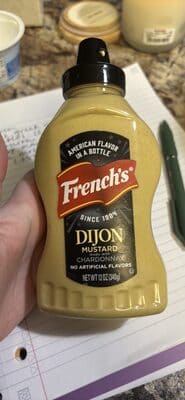
Dijon mustards
French's Dijon Mustard
12 oz
Score
- High in salt
- No additives
Why it scores 79
French's Dijon Mustard scores 79 out of 100 (Good) under GoodSwap’s published rules. What moved the score most:
- minus 9 points Salt 5.5 g / 100 g: Very high in salt. Strong
- minus 8 points Processed (NOVA 3): Classified NOVA 3: processed with added salt, sugar or oil. Emerging
- minus 2.5 points Wine: There is no known safe amount of alcohol use during pregnancy. Regulatory
Capped at 79: High in salt (above the front-of-pack "high" level).
Every line of the math is on The Receipt below, with its evidence tier and sources.
Better mustard
-
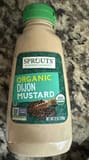 Organic Dijon Mustard Sprouts · 12 oz Less salt Score 97 out of 100 , 18 points higher
 -
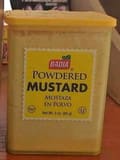 Powdered Mustard Badia · 3 oz (85 g) Less salt Score 100 out of 100 , 21 points higher
 -
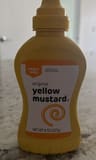 Original Yellow Mustard Smart Way · 8 oz Less salt Score 100 out of 100 , 21 points higher
 -
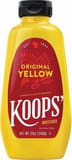 Mustard original yellow Olds Products Co. Less salt Score 95 out of 100 , 16 points higher
 -
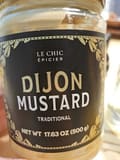 While Grain Mustard Old Style Le Chic Epicier Less salt Score 99 out of 100 , 20 points higher
The same kind of product, at least 10 points higher, sold in the US. Never paid placements.
The Receipt
Dijon Mustard
Ingredients
- Wine minus 2.5 points
Processing
- Processed (NOVA 3) minus 8 points
Nutrition per 100 g
- Salt 5.5 g / 100 g minus 9 points
100 − 19.5 = 80.5 → 81 → capped at 79
Capped at 79. High in salt (above the front-of-pack "high" level). [5]
Nutrition per 100 g
| Energy | 100 kcal |
|---|---|
| Fat | 0 g |
| Saturated fat | 0 g |
| Trans fat | 0 g |
| Carbohydrates | 0 g |
| Sugars | 0 g |
| Added sugars | 0 g |
| Fiber | 0 g |
| Protein | 0 g |
| Salt | 5.5 g |
Serving: 1 tsp (5 g)
Ingredients
Label text, as published
Distilled Vinegar, Water, #1 Grade Mustard Seed, Salt, Chardonnay Wine, Spices & Turmeric.
Allergens and diets
Contains: Mustard
- Vegan
- Vegetarian
- Palm-oil-free
Always check the package: recipes change.
More Dijon mustards on GoodSwap
-
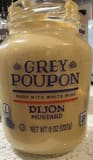 Dijon Mustard Grey Poupon · 227 gr Ultra-processedHigh in saltContains added sugars Score 48 out of 100 Okay
 -
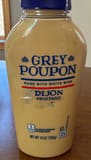 Dijon Mustard Grey Poupon · 10 oz (283 g) Ultra-processedHigh in saltContains added sugars Score 48 out of 100 Okay
 -
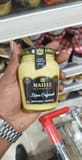 Dijon Originale Mustard Maille · 213 g High in salt Score 75 out of 100 Good
 -
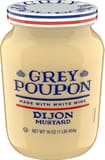 Dijon Mustard Grey Poupon · 454 g Ultra-processedHigh in saltContains added sugars Score 48 out of 100 Okay
 -
 Dijon Mustard Organic Ville · 12 oz High in saltNo additives Score 79 out of 100 Good
 -
 Dijon Mustard Made With White Wine Great Value · 12 oz High in salt Score 79 out of 100 Good
More from French's
Sources
-
About Alcohol Use During Pregnancy
“There is no known safe amount of alcohol use during pregnancy.”
cdc.gov
-
Agents Classified by the IARC Monographs, Volumes 1–142 (List of Classifications)
monographs.iarc.who.int
-
“For adults, WHO recommends less than 2000 mg/day of sodium (equivalent to less than 5 g/day salt), or just under a teaspoon.”
who.int
-
“Table 3: Criteria for drinks (per 100ml)”
assets.publishing.service.gov.uk
-
Dietary Guidelines for Americans, 2025–2030
“Limit foods and beverages that include artificial flavors, petroleum-based dyes, artificial preservatives, and low-calorie non-nutritive sweeteners.”
cdn.realfood.gov