Dips
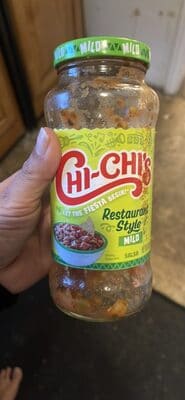
Chi-Chi's Restaurant Style Mild Salsa
16 oz
Score
Why it scores 77
Chi-Chi's Restaurant Style Mild Salsa scores 77 out of 100 (Good) under GoodSwap’s published rules. What moved the score most:
- minus 8 points Processed (NOVA 3): Classified NOVA 3: processed with added salt, sugar or oil. Emerging
- minus 7.5 points Sodium benzoate: Benzoates can form small amounts of benzene in drinks that also contain ascorbic acid (vitamin C), especially with heat or light. Strong
- minus 5 points Salt 1.3 g / 100 g: High in salt. Strong
Every line of the math is on The Receipt below, with its evidence tier and sources.
The Receipt
Restaurant Style Mild Salsa
Ingredients
- Sodium benzoate minus 7.5 points
- Calcium chloride minus 2.5 points
Processing
- Processed (NOVA 3) minus 8 points
Nutrition per 100 g
- Salt 1.3 g / 100 g minus 5 points
100 − 23 = 77
Nutrition per 100 g
| Energy | 33 kcal |
|---|---|
| Fat | 0 g |
| Saturated fat | 0 g |
| Carbohydrates | 6.7 g |
| Sugars | 3.3 g |
| Added sugars | 0 g |
| Fiber | 0 g |
| Protein | 0 g |
| Salt | 1.3 g |
Serving: 2 Tbsp (30 g)
Ingredients
- TOMATOES IN TOMATO JUICE (CONTAINS CITRIC ACID [TO ACIDIFY], CALCIUM CHLORIDE [FIRMING])
- JALAPEO PEPPERS
- WATER
- ONIONS
- TOMATO PASTE
- SALT
- CITRIC ACID (TO ACIDIFY)
- SPICES
- DEHYDRATED GARLIC
- ONION POWDER
- SODIUM BENZOATE (PRESERVATIVE) (moderate concern)
- WHITE VINEGAR
Label text, as published
TOMATOES IN TOMATO JUICE (CONTAINS CITRIC ACID [TO ACIDIFY], CALCIUM CHLORIDE [FIRMING]), JALAPEO PEPPERS, WATER, ONIONS, TOMATO PASTE, CONTAINS 2% OR LESS OF SALT, CITRIC ACID (TO ACIDIFY), SPICES, DEHYDRATED GARLIC, ONION POWDER, SODIUM BENZOATE (PRESERVATIVE), WHITE VINEGAR
Allergens and diets
- Vegan
- Vegetarian
- Palm-oil-free
Always check the package: recipes change.
More dips on GoodSwap
-
 Gourmet Salsa Medium Mateo's · 32 oz High in saltNo additives Score 79 out of 100 Good
 -
 Jack's Cantina Organic Salsa Garden Fresh Gourmet · 48 oz High in saltContains added sugarsCertified organic Score 67 out of 100 Good
 -
 Chunky Salsa Medium Tostitos · 15 oz (425.2 g) Dye with an EU warning labelContains synthetic dyesUltra-processedHigh in salt Score 14 out of 100 Bad
 -
 Cream Cheese! fruit dip Marzetti Not permitted in some countriesUltra-processedContains added sugarsContains emulsifiers studied for gut effects Score 22 out of 100 Poor
 -
 Avocado Mash Trader Joe's · 8 oz No additives Score 95 out of 100 Excellent
 -
 Artichoke Jalapeño Parmesan Premium Dip Stonemill Kitchens · 30 oz Ultra-processedHigh in saltHigh in saturated fatContains seed oils Score 56 out of 100 Okay
More from Chi-Chi's
Sources
-
“Artificial colours or a sodium benzoate preservative (or both) in the diet result in increased hyperactivity in 3-year-old and 8/9-year-old children in the general population.”
doi.org
-
Re-evaluation of benzyl alcohol (E 1519) as food additive (records the 2016 benzoate re-evaluation)
“derived a group ADI of 5 mg/kg bw per day (expressed as benzoic acid) in accordance with the ADI previously derived by SCF and JECFA”
doi.org
-
“For adults, WHO recommends less than 2000 mg/day of sodium (equivalent to less than 5 g/day salt), or just under a teaspoon.”
who.int