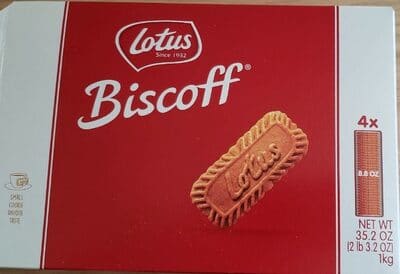
Cookies
Corona - Lotus N.V. Biscoff
35.2 oz
Score
- High in sugar
- High in saturated fat
- Contains added sugars
- Contains seed oils
- Contains palm oil
Why it scores 18
Corona - Lotus N.V. Biscoff scores 18 out of 100 (Bad) under GoodSwap’s published rules. What moved the score most:
- minus 20 points Sugar: An added sugar. Strong
- minus 20 points Brown sugar: An added sugar. Strong
- minus 14 points Sugars 38.7 g / 100 g: Very high in sugar. Strong
Every line of the math is on The Receipt below, with its evidence tier and sources.
The Receipt
Biscoff
Ingredients
- Sugar minus 20 points
- Brown sugar minus 20 points
- Vegetable oil (unspecified) minus 2.5 points
- Soybean oil minus 1.5 points
- Sunflower oil minus 1.5 points
- Canola oil minus 1.5 points
- Palm oil minus 0.5 points
Processing
- Processed (NOVA 3) minus 8 points
Nutrition per 100 g
- Sugars 38.7 g / 100 g minus 14 points
- Saturated fat 8.1 g / 100 g minus 7 points
- Salt 0.9 g / 100 g minus 3 points
- Energy 484 kcal / 100 g minus 3 points
100 − 82.5 = 17.5 → 18
Can’t score above 79. Contains sugar, an ingredient of high concern. [1][2][3]
Can’t score above 79. High in fat, saturated fat and sugars (above the front-of-pack "high" level). [13]
Nutrition per 100 g
| Energy | 484 kcal |
|---|---|
| Fat | 19.4 g |
| Saturated fat | 8.1 g |
| Trans fat | 0 g |
| Carbohydrates | 74.2 g |
| Sugars | 38.7 g |
| Added sugars | 35.5 g |
| Fiber | 0 g |
| Protein | 6.4 g |
| Salt | 0.9 g |
Serving: 4 COOKIES (31 g)
Ingredients
- Wheat Flour
- Sugar (high concern)
- Vegetable Oils (Soybean Oil, Sunflower Oil, Canola Oil, Palm Oil)
- Brown Sugar Syrup (high concern)
- Sodium Bicarbonate (Leavening)
- Soy Flour
- Salt
- Cinnamon
Label text, as published
Wheat Flour, Sugar, Vegetable Oils (Contains one or more of Soybean Oil, Sunflower Oil, Canola Oil, Palm Oil), Brown Sugar Syrup, Sodium Bicarbonate (Leavening), Soy Flour, Salt, Cinnamon. Contains Wheat and Soy.
Allergens and diets
Contains: Soy, Wheat, Gluten
- Vegan
- Vegetarian
- Not gluten-free
- Not palm-oil-free
Always check the package: recipes change.
More cookies on GoodSwap
-
 Fig Bar Blueberry Nature's Bakery · 2 oz Ultra-processedHigh in sugarContains added sugarsContains seed oils Score 14 out of 100 Bad
 -
 Crunchy Breakfast Biscuits Belvita · 1.76 oz Ultra-processedContains added sugarsContains emulsifiers studied for gut effectsContains seed oils Score 15 out of 100 Bad
 -
 belVita Crunchy Blueberry Breakfast Biscuits Belvita · 1.76 oz Ultra-processedHigh in sugarContains added sugarsContains emulsifiers studied for gut effects Score 15 out of 100 Bad
 -
 Nut Butter Bites Nut Butter · 1 oz Ultra-processedHigh in sugarHigh in saturated fatContains added sugars Score 5 out of 100 Bad
 -
 Original Recipe Snack Mix Gardetto's · 14.5 oz Ultra-processedHigh in saltContains added sugarsContains seed oils Score 16 out of 100 Bad
 -
 OATful BITES Member's Mark · 26 g Ultra-processedHigh in sugarHigh in saturated fatContains added sugars Score 11 out of 100 Bad
Sources
-
Guideline: sugars intake for adults and children
“In both adults and children, WHO recommends reducing the intake of free sugars to less than 10% of total energy intake”
who.int
-
Dietary Guidelines for Americans, 2025–2030
“Limit foods and beverages that include artificial flavors, petroleum-based dyes, artificial preservatives, and low-calorie non-nutritive sweeteners.”
cdn.realfood.gov
-
Added and free sugars should be as low as possible
“Sugar consumption is a known cause of dental caries.”
efsa.europa.eu
-
“replacement of saturated fat in the diet with linoleic acid effectively lowers serum cholesterol but does not support the hypothesis that this translates to a lower risk of death from coronary heart disease or all causes.”
doi.org
-
“These data provide support for current recommendations to replace saturated fat with polyunsaturated fat for primary prevention of CHD.”
doi.org
-
Saturated fatty acid and trans-fatty acid intake for adults and children: WHO guideline
“WHO recommends that adults and children reduce saturated fatty acid intake to 10% of total energy intake (strong recommendation).”
who.int
-
Process contaminants in vegetable oils and foods
“The highest levels of GE, as well as 3-MCPD and 2-MCPD (including esters) were found in palm oils and palm fats, followed by other oils and fats.”
efsa.europa.eu
-
“Glycidyl fatty acid esters, expressed as glycidol”
eur-lex.europa.eu
-
“For adults, WHO recommends less than 2000 mg/day of sodium (equivalent to less than 5 g/day salt), or just under a teaspoon.”
who.int
-
“Table 3: Criteria for drinks (per 100ml)”
assets.publishing.service.gov.uk