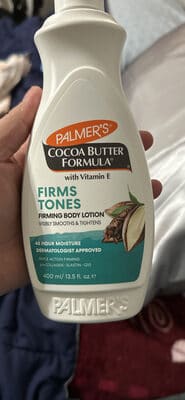
Body lotion
Palmer's Firms Tones Firming Body Lotion
Score
- Contains fragrance
- May contain traces of 1,4-dioxane
- Contains ethanolamines (MEA/DEA/TEA)
Why it scores 91
Palmer's Firms Tones Firming Body Lotion scores 91 out of 100 (Excellent) under GoodSwap’s published rules. What moved the score most:
- minus 5 points Fragrance (parfum): A single label term covers an undisclosed mixture. Regulatory
- minus 1 points Mineral oil and petrolatum: The EU prohibits petrolatum and mineral oils unless the full refining history is known and the source is not a carcinogen. Regulatory
- minus 1 points Propylene glycol: Named Allergen of the Year 2018 by the American Contact Dermatitis Society; it can cause irritant and allergic reactions. Strong
Every line of the math is on The Receipt below, with its evidence tier and sources.
The Receipt
Firms Tones Firming Body Lotion
Ingredients
- Fragrance (parfum) minus 5 points
- Mineral oil and petrolatum minus 1 points
- Propylene glycol minus 1 points
- Triethanolamine (TEA) minus 0.5 points
- Polyethylene glycols (PEG) and ethoxylates minus 0.5 points
- Phenoxyethanol minus 0.5 points
- Benzyl benzoate minus 0.5 points
- Benzyl cinnamate minus 0.5 points
100 − 9.5 = 90.5 → 91
Ingredients
- Water (Aqua)
- Mineral Oil (Paraffinum Liquidum)
- Theobroma Cacao (Cocoa) Extract
- Isopropyl Myristate
- Propylene Glycol
- Cetyl Alcohol
- Palmitic Acid
- Stearic Acid
- Theobroma Cacao (Cocoa) Seed Butter
- Butyrospermum Parkii (Shea) Butter
- Tocopherol
- Cocos Nucifera (Coconut) Oil
- Hydrolyzed Vegetable Protein
- Hydrolyzed Elastin
- Glycerin
- Camellia Oleifera Seed Extract
- Chamomilla Recutita (Matricaria) Flower Extract
- Panax Ginseng Root Extract
- Ubiquinone
- Dimethicone
- Lecithin
- Carnitine
- Helianthus Annuus (Sunflower) Seed Oil
- Leuconostoc/Radish Root Ferment Filtrate
- Polyimide-1 (not recognized)
- Triethanolamine
- PEG-40 Stearate
- Stearyl Alcohol
- Carbomer
- Ethylhexylglycerin
- Tetrasodium EDTA
- Acrylates Copolymer
- Phenoxyethanol
- Butylene Glycol
- Fragrance (Parfum) (moderate concern)
- Benzyl Benzoate
- Benzyl Cinnamate
Label text, as published
Water (Aqua), Mineral Oil (Paraffinum Liquidum), Theobroma Cacao (Cocoa) Extract, Isopropyl Myristate, Propylene Glycol, Cetyl Alcohol, Palmitic Acid, Stearic Acid, Theobroma Cacao (Cocoa) Seed Butter, Butyrospermum Parkii (Shea) Butter, Tocopherol, Cocos Nucifera (Coconut) Oil, Hydrolyzed Vegetable Protein, Hydrolyzed Elastin, Glycerin, Camellia Oleifera Seed Extract, Chamomilla Recutita (Matricaria) Flower Extract, Panax Ginseng Root Extract, Ubiquinone, Dimethicone, Lecithin, Carnitine, Helianthus Annuus (Sunflower) Seed Oil, Leuconostoc/Radish Root Ferment Filtrate, Polyimide-1, Triethanolamine, PEG-40 Stearate, Stearyl Alcohol, Carbomer, Ethylhexylglycerin, Tetrasodium EDTA, Acrylates Copolymer, Phenoxyethanol, Butylene Glycol, Fragrance (Parfum), Benzyl Benzoate, Benzyl Cinnamate
Allergens and diets
Contains: Milk
- Not vegan
Always check the package: recipes change.
Sources
-
“when their concentration exceeds 0,001 % in leave-on products and 0,01 % in rinse-off products.”
eur-lex.europa.eu
-
Regulation (EC) No 1223/2009 of 30 November 2009 on cosmetic products
“cosmetic products shall not contain any of the following: (a) prohibited substances — prohibited substances listed in Annex II”
eur-lex.europa.eu
-
fda.gov
-
“Allergic and irritant contact dermatitis and systemic cutaneous reactions to PG, which has become an increasingly common ingredient, have been documented.”
doi.org
-
Agents Classified by the IARC Monographs, Volumes 1–142 (List of Classifications)
monographs.iarc.who.int
-
1,4-Dioxane in Cosmetics: A Manufacturing Byproduct
“1,4-dioxane forms as a byproduct during the manufacturing process of certain cosmetic ingredients.”
fda.gov
-
“The NTP study did not establish a link between DEA and the risk of cancer in humans.”
fda.gov