Food
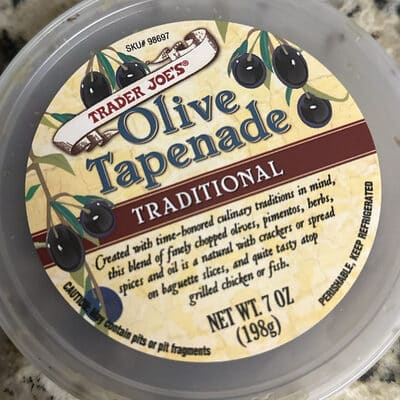
Trader Joe's Olive Tapenade
7 oz
Score
- Ultra-processed
- High in salt
- No synthetic dyes
Why it scores 70
Trader Joe's Olive Tapenade scores 70 out of 100 (Good) under GoodSwap’s published rules. What moved the score most:
- minus 18 points Ultra-processed (NOVA 4): Classified NOVA 4: made with industrial ingredients and additives. Strong
- minus 7 points Salt 2.1 g / 100 g: Very high in salt. Strong
- minus 3 points Saturated fat 3.3 g / 100 g: High in saturated fat. Strong
Every line of the math is on The Receipt below, with its evidence tier and sources.
The Receipt
Olive Tapenade
Ingredients
- Wine minus 2.5 points
Processing
- Ultra-processed (NOVA 4) minus 18 points
Nutrition per 100 g
- Saturated fat 3.3 g / 100 g minus 3 points
- Salt 2.1 g / 100 g minus 7 points
- Energy 333 kcal / 100 g minus 2 points
- Fiber 3.3 g / 100 g plus 2 points
100 − 30.5 = 69.5 → 70
Can’t score above 79. High in fat and salt (above the front-of-pack "high" level). [7]
Nutrition per 100 g
| Energy | 333 kcal |
|---|---|
| Fat | 33.3 g |
| Saturated fat | 3.3 g |
| Trans fat | 0 g |
| Carbohydrates | 6.7 g |
| Sugars | 0 g |
| Added sugars | 0 g |
| Fiber | 3.3 g |
| Protein | 0 g |
| Salt | 2.1 g |
Serving: 2 tbsp (30 g)
Ingredients
- BLACK OLIVES (BLACK OLIVES, WATER, SALT, FERROUS, GLUCONATE (TO STABILIZE COLOR))
- GREEN OLIVES
- WATER
- SALT
- CITRIC ACID (TO PRESERVE)
- LACTIC (not recognized)
- ACID (not recognized)
- ASCORBIC ACID (TO MAINTAIN COLOR)
- PIMIENTOS (PIMIENTO, PEPPERS, WATER, CITRIC ACID)
- CAPERS
- WATER
- DISTILLED VINEGAR
- SALT)
- DIJON MUSTARD (DISTILLED VINEGAR, WATER, MUSTARD SEED, SEA SALT, WHITE WINE, CITRIC ACID, SACIDIFIER)
- TURMERIC (FOR COLOR)
- BLACK PEPPER)
- LEMON JUICE
- CONCENTRATE (not recognized)
- MARJORAM
- DEHYDRATED GARLIC
- BLACK PEPPER
Label text, as published
BLACK OLIVES (BLACK OLIVES, WATER, SALT, FERROUS, GLUCONATE (TO STABILIZE COLOR)), GREEN OLIVES, WATER, SALT, CITRIC ACID (TO PRESERVE), LACTIC, ACID, ASCORBIC ACID (TO MAINTAIN COLOR), PIMIENTOS (PIMIENTO, PEPPERS, WATER, CITRIC ACID) (ACIDIFIER), CAPERS, WATER, DISTILLED VINEGAR, SALT), DIJON MUSTARD (DISTILLED VINEGAR,, WATER, MUSTARD SEED, SEA SALT, WHITE WINE, CITRIC ACID, SACIDIFIER), TURMERIC (FOR COLOR), BLACK PEPPER), LEMON JUICE, CONCENTRATE, MARJORAM, DEHYDRATED GARLIC, BLACK PEPPER
Allergens and diets
Contains: Mustard
- Palm-oil-free
Always check the package: recipes change.
More from Trader Joe's
Sources
-
About Alcohol Use During Pregnancy
“There is no known safe amount of alcohol use during pregnancy.”
cdc.gov
-
Agents Classified by the IARC Monographs, Volumes 1–142 (List of Classifications)
monographs.iarc.who.int
-
Saturated fatty acid and trans-fatty acid intake for adults and children: WHO guideline
“WHO recommends that adults and children reduce saturated fatty acid intake to 10% of total energy intake (strong recommendation).”
who.int
-
“For adults, WHO recommends less than 2000 mg/day of sodium (equivalent to less than 5 g/day salt), or just under a teaspoon.”
who.int
-
Dietary Guidelines for Americans, 2025–2030
“Limit foods and beverages that include artificial flavors, petroleum-based dyes, artificial preservatives, and low-calorie non-nutritive sweeteners.”
cdn.realfood.gov
-
“Table 3: Criteria for drinks (per 100ml)”
assets.publishing.service.gov.uk
-
“Greater exposure to ultra-processed food was associated with a higher risk of adverse health outcomes, especially cardiometabolic, common mental disorder, and mortality outcomes.”
doi.org