Sunflower oils
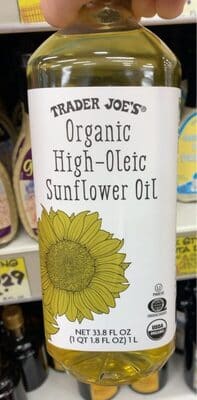
Trader Joe's Organic high-oleic sunflower oil
One 1 L
Score
- Contains seed oils
- Certified organic
- No additives
Why it scores 100
Trader Joe's Organic high-oleic sunflower oil scores 100 out of 100 (Excellent) under GoodSwap’s published rules. What moved the score most:
- plus 5 points Certified organic: Carries a certified-organic label. Info
- plus 5 points Simple whole food: A few low-concern ingredients, minimally processed. Info
- minus 2.5 points Sunflower oil: High in omega-6 linoleic acid. Emerging
Every line of the math is on The Receipt below, with its evidence tier and sources.
The Receipt
Organic high-oleic sunflower oil
Ingredients
- Sunflower oil minus 2.5 points
Bonuses
- Certified organic plus 5 points
- Simple whole food plus 5 points
100 + 7.5 = 107.5 → 100
Nutrition per 100 g
| Energy | 800 kcal |
|---|---|
| Fat | 93.3 g |
| Saturated fat | 10 g |
| Trans fat | 0 g |
| Carbohydrates | 0 g |
| Protein | 0 g |
| Salt | 0 g |
Serving: 1 tbsp. (15 ml)
Ingredients
Label text, as published
Organic High-Oleic Sunflower Oil
Allergens and diets
- Vegan
- Vegetarian
- Gluten-free
- Palm-oil-free
Always check the package: recipes change.
More from Trader Joe's
-
 Cracked Wheat Sourdough Bread Trader Joe's · 24 oz Score 86 out of 100 Excellent
 -
 Vanilla Almond Granola Trader Joe's · 16 oz Score 22 out of 100 Poor
 -
 Grilled Pitted Chalkidiki Variety Green Olives in oil Trader Joe's Score 90 out of 100 Excellent
 -
 Taiwanese Green Onion Pancakes Trader Joe's Score 70 out of 100 Good
Sources
-
“replacement of saturated fat in the diet with linoleic acid effectively lowers serum cholesterol but does not support the hypothesis that this translates to a lower risk of death from coronary heart disease or all causes.”
doi.org
-
“These data provide support for current recommendations to replace saturated fat with polyunsaturated fat for primary prevention of CHD.”
doi.org
-
7 CFR 205.102 Use of the term "organic" (National Organic Program)
“Any agricultural product that is sold, labeled, or represented as “100 percent organic,” “organic,” or “made with organic (specified ingredients or food group(s))” must be: (a) Produced in accordance with the requirements specified in § 205.101 or §§ 205.202 through 205.207”
ecfr.gov