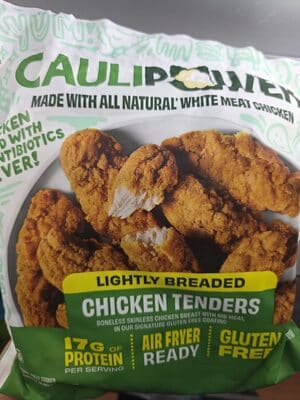
Chicken nuggets
Caulipower Chicken Tenders
14 oz/392 g
Score
- Ultra-processed
- No synthetic dyes
- Contains whole grains
Why it scores 71
Caulipower Chicken Tenders scores 71 out of 100 (Good) under GoodSwap’s published rules. What moved the score most:
- minus 18 points Ultra-processed (NOVA 4): Classified NOVA 4: made with industrial ingredients and additives. Strong
- minus 4.5 points 4 kinds of ultra-processing markers: Industrial additive classes found: color (added), firming agent, flavor enhancer and flavoring. Emerging
- plus 4 points Protein 16.7 g / 100 g: A good source of protein. Info
Every line of the math is on The Receipt below, with its evidence tier and sources.
Better chicken nuggets and tenders
-
 Bone-In, Skin-On Chicken Drumsticks Just Bare · 112 g Not ultra-processed · No calcium lactate Score 100 out of 100 , 29 points higher
 -
 Organic Grilled Chicken Breast Strips with Rib Meat Whole Foods Market · 8 oz Not ultra-processed · No calcium lactate Score 100 out of 100 , 29 points higher
 -
 Boneless, Skinless Chicken Tenderloins Just Bare · 112 g Not ultra-processed · No calcium lactate Score 100 out of 100 , 29 points higher
 -
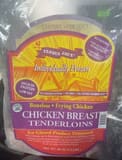 Chicken Breast Tenderloins Trader Joe's · 40 oz Not ultra-processed · No calcium lactate Score 100 out of 100 , 29 points higher
 -
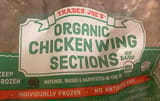 Organic Chicken Wing Sections Trader Joe's · 32 oz Not ultra-processed · No calcium lactate Score 100 out of 100 , 29 points higher
The same kind of product, at least 10 points higher, sold in the US. Never paid placements.
The Receipt
Chicken Tenders
Ingredients
- Natural flavors minus 2.5 points
- Calcium lactate minus 2.5 points
- Yeast extract minus 2.5 points
Processing
- Ultra-processed (NOVA 4) minus 18 points
- 4 kinds of ultra-processing markers minus 4.5 points
Nutrition per 100 g
- Salt 1.1 g / 100 g minus 3 points
- Protein 16.7 g / 100 g plus 4 points
100 − 29 = 71
Nutrition per 100 g
| Energy | 131 kcal |
|---|---|
| Fat | 1.8 g |
| Saturated fat | 0 g |
| Trans fat | 0 g |
| Carbohydrates | 13.1 g |
| Sugars | 0 g |
| Added sugars | 0 g |
| Fiber | 1.2 g |
| Protein | 16.7 g |
| Salt | 1.1 g |
Serving: 2 tenders (84 g)
Ingredients
- CHICKEN BREAST
- WATER
- RICE FLOUR
- DRIED CAULIFLOWER
- BROWN RICE FLOUR
- TAPIOCA STARCH
- SALT
- SEASONING (CHICKEN BROTH, NATURAL FLAVOR)
- ORGANIC CORN STARCH
- RICE STARCH
- ORGANIC YELLOW CORN FLOUR
- SEA SALT
- GARLIC POWDER
- LEAVENING (CREAM OF TARTAR, SODIUM BICARBONATE) (not recognized)
- ONION POWDER
- SPICES
- PAPRIKA
- LACTIC ACID POWDER
- CALCIUM LACTATE
- TORULA YEAST
- EXTRACTIVES OF PAPRIKA
Label text, as published
CHICKEN BREAST, WATER, RICE FLOUR, DRIED CAULIFLOWER, BROWN RICE FLOUR. CONTAINS 2% OR LESS OF THE FOLLOWING: TAPIOCA STARCH, SALT, SEASONING (CHICKEN BROTH, NATURAL FLAVOR), ORGANIC CORN STARCH, RICE STARCH, ORGANIC YELLOW CORN FLOUR, SEA SALT, GARLIC POWDER, LEAVENING (CREAM OF TARTAR, SODIUM BICARBONATE), ONION POWDER, SPICES, PAPRIKA, LACTIC ACID POWDER, CALCIUM LACTATE, TORULA YEAST, EXTRACTIVES OF PAPRIKA.
Allergens and diets
- Not vegan
- Not vegetarian
- Palm-oil-free
Always check the package: recipes change.
More chicken nuggets on GoodSwap
-
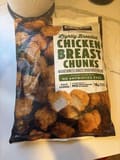 Lightly Breaded Chicken Breast Chunks Kirkland · 64 oz High in saltContains added sugarsContains seed oils Score 63 out of 100 Good
 -
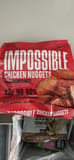 Chicken Nuggets Impossible · 13.5 oz (383 g) Ultra-processedContains added sugarsContains seed oilsNo synthetic dyes Score 20 out of 100 Poor
 -
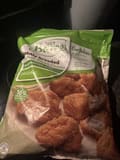 Lightly Breaded Chicken Breast Chunks Just Bare · 64 oz (4 lb) Ultra-processedContains added sugarsContains seed oils Score 53 out of 100 Okay
 -
 Plant-Based Seven Grain Crispy Tenders Gardein · 9 oz/255 g Not permitted in some countriesUltra-processedContains added sugarsContains seed oils Score 25 out of 100 Poor
 -
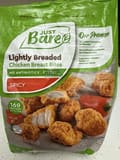 Lightly Breaded Chicken Breast Bites Spicy Just Bare · 24 oz High in saltContains added sugarsContains seed oilsNo synthetic dyes Score 66 out of 100 Good
 -
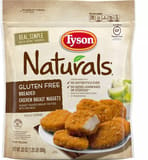 Chicken breast nuggets, gluten free Tyson · 20 oz Ultra-processedContains added sugarsContains seed oilsNo synthetic dyes Score 46 out of 100 Okay
More from Caulipower
Sources
-
21 CFR 101.22 Foods; labeling of spices, flavorings, colorings and chemical preservatives
“whose significant function in food is flavoring rather than nutritional.”
ecfr.gov
-
“For adults, WHO recommends less than 2000 mg/day of sodium (equivalent to less than 5 g/day salt), or just under a teaspoon.”
who.int
-
Dietary Guidelines for Americans, 2025–2030
“Limit foods and beverages that include artificial flavors, petroleum-based dyes, artificial preservatives, and low-calorie non-nutritive sweeteners.”
cdn.realfood.gov
-
“Greater exposure to ultra-processed food was associated with a higher risk of adverse health outcomes, especially cardiometabolic, common mental disorder, and mortality outcomes.”
doi.org