Food
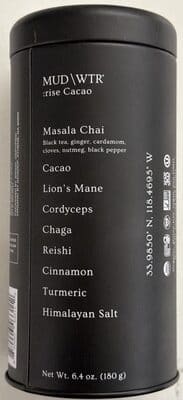
Mudwtr MUD \\ WTR Original
Score
- Contains caffeine
- No additives
- Contains whole grains
Why it scores 100
Mudwtr MUD \\ WTR Original scores 100 out of 100 (Excellent) under GoodSwap’s published rules. What moved the score most:
- plus 4 points Fiber 16.7 g / 100 g: A good source of fiber. Strong
- plus 3 points No additives: No food additives in the ingredient list. Info
- minus 2 points Energy 333 kcal / 100 g: Energy-dense for its weight. Info
Every line of the math is on The Receipt below, with its evidence tier and sources.
The Receipt
MUD \\ WTR Original
Nutrition per 100 g
- Salt 0.4 g / 100 g minus 1 points
- Energy 333 kcal / 100 g minus 2 points
- Fiber 16.7 g / 100 g plus 4 points
- Protein 16.7 g / 100 g plus 2 points
Bonuses
- No additives plus 3 points
100 + 6 = 100
Nutrition per 100 g
| Energy | 333 kcal |
|---|---|
| Fat | 8.3 g |
| Carbohydrates | 66.7 g |
| Sugars | 0 g |
| Added sugars | 0 g |
| Fiber | 16.7 g |
| Protein | 16.7 g |
| Salt | 0.4 g |
Serving: 1 portion (6 g)
Ingredients
- Organic Mushroom Blend (Chaga, Reishi, Lion's Mane and Cordyceps Mushrooms and Mycelium cultured on Organic Oats, Organic Sorghum)
- Organic Cacao
- Organic Spice Blend (Organic Cinnamon, Organic Turmeric, Organic Ginger, Organic Cardamom, Organic Black Pepper, Organic Nutmeg, Organic Cloves)
- Organic Black Tea Powder
- Himalayan Pink Salt
Label text, as published
Organic Mushroom Blend (Chaga, Reishi, Lion's Mane and Cordyceps Mushrooms and Mycelium cultured on Organic Oats and/or Organic Sorghum), Organic Cacao, Organic Spice Blend (Organic Cinnamon, Organic Turmeric, Organic Ginger, Organic Cardamom, Organic Black Pepper, Organic Nutmeg, Organic Cloves), Organic Black Tea Powder, Himalayan Pink Salt
Allergens and diets
- Vegan
- Vegetarian
- Gluten-free
- Palm-oil-free
Always check the package: recipes change.
Sources
-
“For adults, WHO recommends less than 2000 mg/day of sodium (equivalent to less than 5 g/day salt), or just under a teaspoon.”
who.int
-
Dietary Guidelines for Americans, 2025–2030
“Limit foods and beverages that include artificial flavors, petroleum-based dyes, artificial preservatives, and low-calorie non-nutritive sweeteners.”
cdn.realfood.gov
-
Spilling the Beans: How Much Caffeine is Too Much?
“For most adults, the FDA has cited 400 milligrams* a day — that's about two to three 12-fluid-ounce cups of coffee — as an amount not generally associated with negative effects.”
fda.gov
-
Regulation (EU) No 1169/2011, Annex III point 4.1 (beverages with high caffeine content)
“‘High caffeine content. Not recommended for children or pregnant or breast-feeding women’”
eur-lex.europa.eu