Food
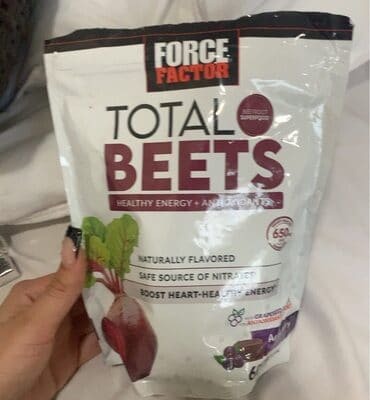
Force Factor Total Beets
Score
- Ultra-processed
- Contains nitrites or nitrates
- Contains added sugars
- Contains seed oils
- Contains palm oil
- No synthetic dyes
Why it scores 28
Force Factor Total Beets scores 28 out of 100 (Poor) under GoodSwap’s published rules. What moved the score most:
- minus 20 points Corn syrup: An added sugar. Strong
- minus 20 points Sugar: An added sugar. Strong
- minus 18 points Ultra-processed (NOVA 4): Classified NOVA 4: made with industrial ingredients and additives. Strong
Every line of the math is on The Receipt below, with its evidence tier and sources.
The Receipt
Total Beets
Ingredients
- Corn syrup minus 20 points
- Sugar minus 20 points
- Sodium nitrite minus 10 points
Processing
- Ultra-processed (NOVA 4) minus 18 points
- 4 kinds of ultra-processing markers minus 4.5 points
100 − 72.5 = 27.5 → 28
Can’t score above 79. Contains corn syrup, an ingredient of high concern. [1][2][3][4][5][6][7][8]
Nutrition per 100 g
| Fat | 0 g |
|---|---|
| Saturated fat | 0 g |
| Carbohydrates | 6.7 g |
| Sugars | 3.3 g |
| Added sugars | 0.5 g |
| Protein | 0 g |
| Salt | 0 g |
Ingredients
- Added Sugars Niacin (as Niacinamide) Vitamin B6 (as Pyridoxine HCI) Vitamin B12 (as Methylcobalamin) 1%* 1%* ‡ 4%* 10 ng 63% ng 118% (cg 1042% Total Beets® Superfood Superblend mg Beet (Beta vulgaris) Powder (root), Grape (Vitis vinifera) Extract (seed), NO3-T® Nitrate Powder (from beetroot extract) (std for 10° nitrate), L-Citrulline * Percent, (DV) not established Other Tapioca Syrup, Raw - Sugar, Palm Oil, Gum Arabic, Natural Flavor, Sunflower Lech (an emulsifier), Fruit and Vegetable Juice (Color), Citric Acid, S salt Keep out of reach of children For aduit use only peanuts, sesame Precautions: Use only as directed Consult a healthcare professional before use if you are pregnant or nursing, have a medical condition, or use prescription medications This product contains nitrates and should not be used in combination with other products containing nitrates, including medication for chest pain or erectile dysfunction, such as PDE-5 inhibitors Discontinue use two weeks prior to surgery Store in a cool, dry place Protect from heat, light, moisture These statements have not been evaluated by the Food and Drug Administration This product is not intended to diagnose, treat, cure, or prevent any disease NOBT NO3-T® is a registered trademark of ThermoLife International NITRATE LLC This mark covers the use of one or more patents listed at wwwNO3-Tcom/patents ^Nielsen XAOC, LLC Boston, MA 02210 1-866-44-FORCE Proudly manufactured in the US from 8 imported and domestic 18594 01545 FFS-01042-SL 0 23-2) (not recognized)
Label text, as published
inname 1,000 mg Supplement Fac's Serving Size 1 Soft Chew Servings Per Container 60 Amount Per Serviny %DV Calories Total Fat Total Carbohydrate Total Sugars 20 05 g 4 g 2 g Includes 2g Added Sugars Niacin (as Niacinamide) Vitamin B6 (as Pyridoxine HCI) Vitamin B12 (as Methylcobalamin) 1%* 1%* ‡ 4%* 10 ng 63% ng 118% (cg 1042% Total Beets® Superfood Superblend mg Beet (Beta vulgaris) Powder (root), Grape (Vitis vinifera) Extract (seed), NO3-T® Nitrate Powder (from beetroot extract) (std for 10° nitrate), L-Citrulline * Percent Daily Values are based on a 2,0 alorie diet # Daily Value (DV) not established Other Tapioca Syrup, Raw - Sugar, Palm Oil, Gum Arabic, Natural Flavor, Sunflower Lech (an emulsifier), Fruit and Vegetable Juice (Color), Citric Acid, S salt Keep out of reach of children For aduit use only peanuts, and sesame Precautions: Use only as directed Consult a healthcare professional before use if you are pregnant or nursing, have a medical condition, or use prescription medications This product contains nitrates and should not be used in combination with other products containing nitrates, including medication for chest pain or erectile dysfunction, such as PDE-5 inhibitors Discontinue use two weeks prior to surgery Store in a cool, dry place Protect from heat, light, and moisture These statements have not been evaluated by the Food and Drug Administration This product is not intended to diagnose, treat, cure, or prevent any disease NOBT NO3-T® is a registered trademark of ThermoLife International NITRATE LLC This mark covers the use of one or more patents listed at wwwNO3-Tcom/patents ^Nielsen XAOC, L52 W/E 22523 WWWFORCEFACTORCOM Distributed by Force Factor, LLC Boston, MA 02210 1-866-44-FORCE Proudly manufactured in the US from 8 imported and domestic 18594 01545 FFS-01042-SL 0 23-2
Allergens and diets
Contains: Sesame
- Not palm-oil-free
Always check the package: recipes change.
More from Force Factor
Sources
-
Guideline: sugars intake for adults and children
“In both adults and children, WHO recommends reducing the intake of free sugars to less than 10% of total energy intake”
who.int
-
Dietary Guidelines for Americans, 2025–2030
“Limit foods and beverages that include artificial flavors, petroleum-based dyes, artificial preservatives, and low-calorie non-nutritive sweeteners.”
cdn.realfood.gov
-
Added and free sugars should be as low as possible
“Sugar consumption is a known cause of dental caries.”
efsa.europa.eu
-
Agents Classified by the IARC Monographs, Volumes 1–142 (List of Classifications)
monographs.iarc.who.int
-
“the presence of nitrites and nitrates in foods can give rise to the formation of nitrosamines some of which are carcinogenic.”
eur-lex.europa.eu
-
EFSA confirms safe levels for nitrites and nitrates added to food
“They concluded that when nitrites are used at approved levels, their contribution to overall exposure to nitrosamines is of low concern for health.”
efsa.europa.eu
-
Nitrosamines in food raise a health concern
“Nitrosamines in food raise a health concern”
efsa.europa.eu
-
“Greater exposure to ultra-processed food was associated with a higher risk of adverse health outcomes, especially cardiometabolic, common mental disorder, and mortality outcomes.”
doi.org
-
“replacement of saturated fat in the diet with linoleic acid effectively lowers serum cholesterol but does not support the hypothesis that this translates to a lower risk of death from coronary heart disease or all causes.”
doi.org
-
“These data provide support for current recommendations to replace saturated fat with polyunsaturated fat for primary prevention of CHD.”
doi.org
-
“Glycidyl fatty acid esters, expressed as glycidol”
eur-lex.europa.eu