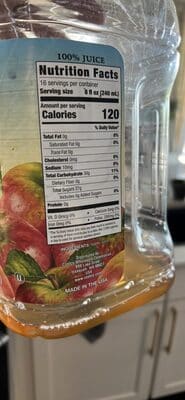
Apple juices
Kirkland 100% JUICE (not from concentrate)
1 gallon, 3.79 L
Score
- No additives
Why it scores 90
Kirkland 100% JUICE (not from concentrate) scores 90 out of 100 (Excellent) under GoodSwap’s published rules. What moved the score most:
- minus 14 points Sugars 11.2 g / 100 ml: Very high in sugar. Strong
- plus 5 points Simple whole food: A few low-concern ingredients, minimally processed. Info
- minus 4 points Energy 50 kcal / 100 ml: Energy-dense for its volume. Info
Every line of the math is on The Receipt below, with its evidence tier and sources.
Better juices and juice drinks
-
 Juice From Concentrate Del Monte · 8 mL Scores +10 Score 100 out of 100 , 10 points higher
 -
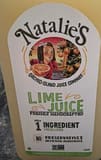 Not From Concentrate Pure Lime Juice Natalie's · 32 fl oz/946 mL Scores +10 Score 100 out of 100 , 10 points higher
 -
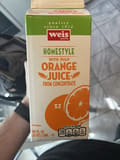 Orange Juice From Concentrate With Pulp Weis · 240 mL Scores +10 Score 100 out of 100 , 10 points higher
 -
 Original 100% Orange Juice From Concentrate Publix Scores +10 Score 100 out of 100 , 10 points higher
 -
 100% Orange Juice from Concentrate Suncup · 4 fl oz (118 mL) Scores +10 Score 100 out of 100 , 10 points higher
The same kind of product, at least 10 points higher, sold in the US. Never paid placements.
The Receipt
100% JUICE (not from concentrate)
Nutrition per 100 ml
- Sugars 11.2 g / 100 ml minus 14 points
- Energy 50 kcal / 100 ml minus 4 points
Bonuses
- Simple whole food plus 5 points
- No additives plus 3 points
100 − 10 = 90
Nutrition per 100 ml
| Energy | 50 kcal |
|---|---|
| Fat | 0 g |
| Saturated fat | 0 g |
| Trans fat | 0 g |
| Carbohydrates | 12.5 g |
| Sugars | 11.2 g |
| Added sugars | 0 g |
| Fiber | 0 g |
| Protein | 0 g |
| Salt | 0 g |
Serving: 1 portion (240 ml)
Ingredients
Label text, as published
Apple juice
Allergens and diets
- Vegan
- Vegetarian
- Gluten-free
- Palm-oil-free
Always check the package: recipes change.
Packaging
Plastic
Context only: no points in v1.
More apple juices on GoodSwap
-
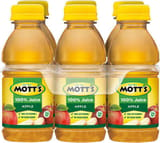 Apple Juice Mott's · 8 fl oz High in sugarContains added sugars Score 62 out of 100 Good
 -
 Apple 100% Juice Great Value · 2.84 L High in sugarContains added sugars Score 62 out of 100 Good
 -
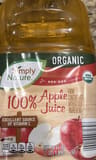 100% Apple Juice Simply Nature High in sugarContains added sugarsCertified organic Score 62 out of 100 Good
 -
 Apple juice Mott's High in sugarContains added sugars Score 62 out of 100 Good
 - 100% Juice Juicy Juice · 54 fl oz/1.68 qt/1.6 L Ultra-processedHigh in sugarContains added sugars Score 40 out of 100 Okay
-
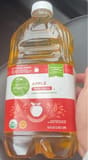 Apple juice Simple Truth Organic · 64 fl oz/2 Quart/1.89 L High in sugarContains added sugarsCertified organicNo additives Score 62 out of 100 Good
More from Kirkland
Sources
-
Guideline: sugars intake for adults and children
“In both adults and children, WHO recommends reducing the intake of free sugars to less than 10% of total energy intake”
who.int
-
Dietary Guidelines for Americans, 2025–2030
“Limit foods and beverages that include artificial flavors, petroleum-based dyes, artificial preservatives, and low-calorie non-nutritive sweeteners.”
cdn.realfood.gov