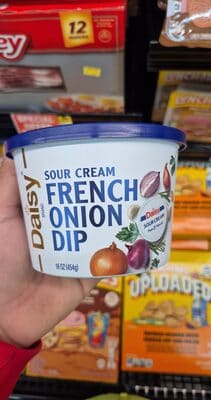
Dips
Daisy Sour Cream French Onion Dip
16 oz/454 g
Score
- High in saturated fat
- Contains added sugars
- No additives
Why it scores 57
Daisy Sour Cream French Onion Dip scores 57 out of 100 (Okay) under GoodSwap’s published rules. What moved the score most:
- minus 20 points Sugar: An added sugar. Strong
- minus 9 points Saturated fat 11.7 g / 100 g: Very high in saturated fat. Strong
- minus 8 points Processed (NOVA 3): Classified NOVA 3: processed with added salt, sugar or oil. Emerging
Every line of the math is on The Receipt below, with its evidence tier and sources.
Better dips and spreads
-
 Organic Serrano & Onion Black Bean Dip Better Bean · 8 oz Less saturated fat · No added sugars Score 100 out of 100 , 43 points higher
 -
 French Onion Dip Plant Perks · 6.5 oz/184 g Less saturated fat · No sugar Score 78 out of 100 , 21 points higher
 -
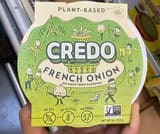 French Onion Credo · 9 oz (255 g) Less saturated fat · No added sugars Score 79 out of 100 , 22 points higher
 -
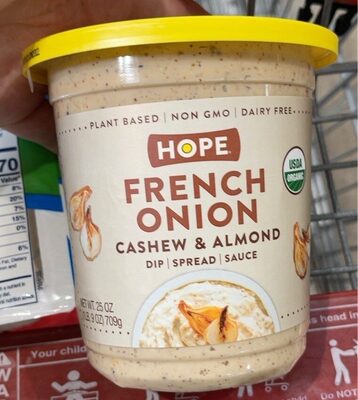 French Onion Cashew & Almond Dip No added sugars · No sugar Score 79 out of 100 , 22 points higher
 -
 Wild Creamery Cultured Plant Based French Onion Dip Wildcreamery · 8.5 oz No added sugars · No sugar Score 79 out of 100 , 22 points higher
The same kind of product, at least 10 points higher, sold in the US. Never paid placements.
The Receipt
Sour Cream French Onion Dip
Ingredients
- Sugar minus 20 points
Processing
- Processed (NOVA 3) minus 8 points
Nutrition per 100 g
- Saturated fat 11.7 g / 100 g minus 9 points
- Salt 1.3 g / 100 g minus 5 points
- Energy 200 kcal / 100 g minus 1 points
100 − 43 = 57
Can’t score above 79. Contains sugar, an ingredient of high concern. [1][2][3]
Can’t score above 79. High in saturated fat (above the front-of-pack "high" level). [7]
Nutrition per 100 g
| Energy | 200 kcal |
|---|---|
| Fat | 16.7 g |
| Saturated fat | 11.7 g |
| Trans fat | 0 g |
| Carbohydrates | 6.7 g |
| Sugars | 3.3 g |
| Added sugars | 0 g |
| Fiber | 0 g |
| Protein | 3.3 g |
| Salt | 1.3 g |
Serving: 2 tbsp (30 g)
Ingredients
Label text, as published
CULTURED CREAM, DRIED ONION, SALT, SUGAR, DRIED GARLIC, SPICES, DRIED PARSLEY
Allergens and diets
Contains: Milk
- Not vegan
- Vegetarian
- Gluten-free
- Palm-oil-free
Always check the package: recipes change.
More dips on GoodSwap
-
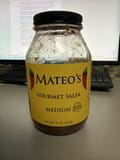 Gourmet Salsa Medium Mateo's · 32 oz High in saltNo additives Score 79 out of 100 Good
 -
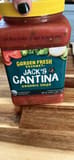 Jack's Cantina Organic Salsa Garden Fresh Gourmet · 48 oz High in saltContains added sugarsCertified organic Score 67 out of 100 Good
 -
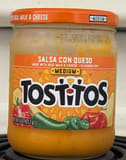 Chunky Salsa Medium Tostitos · 15 oz (425.2 g) Dye with an EU warning labelContains synthetic dyesUltra-processedHigh in salt Score 14 out of 100 Bad
 -
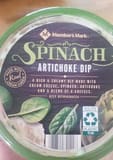 Spinach artichoke dip Member's Mark · 24 lb Ultra-processedHigh in saturated fatContains added sugarsContains seed oils Score 32 out of 100 Poor
 -
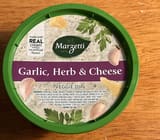 Garlic, Herb & Cheese Veggie Dip Marzetti Ultra-processedHigh in saltHigh in saturated fatContains added sugars Score 36 out of 100 Poor
 - Jalfrezi Curry Indian Simmer Sauce Sweet Red Pepper & Tomato Maya Kaimal · 12.5 oz/354 g Ultra-processedContains seed oilsNo additives Score 79 out of 100 Good
More from Daisy



Sources
-
Guideline: sugars intake for adults and children
“In both adults and children, WHO recommends reducing the intake of free sugars to less than 10% of total energy intake”
who.int
-
Dietary Guidelines for Americans, 2025–2030
“Limit foods and beverages that include artificial flavors, petroleum-based dyes, artificial preservatives, and low-calorie non-nutritive sweeteners.”
cdn.realfood.gov
-
Added and free sugars should be as low as possible
“Sugar consumption is a known cause of dental caries.”
efsa.europa.eu
-
Saturated fatty acid and trans-fatty acid intake for adults and children: WHO guideline
“WHO recommends that adults and children reduce saturated fatty acid intake to 10% of total energy intake (strong recommendation).”
who.int
-
“For adults, WHO recommends less than 2000 mg/day of sodium (equivalent to less than 5 g/day salt), or just under a teaspoon.”
who.int
-
“Table 3: Criteria for drinks (per 100ml)”
assets.publishing.service.gov.uk