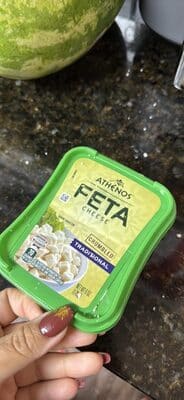
Why it scores 83
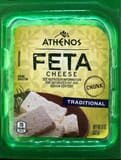
Athenos Feta Cheese scores 83 out of 100 (Excellent) under GoodSwap’s published rules. What moved the score most:
- minus 8 points Processed (NOVA 3): Classified NOVA 3: processed with added salt, sugar or oil. Emerging
- minus 3 points Salt 0.8 g / 100 g: High in salt. Strong
- minus 2.5 points Powdered cellulose: An additive class typical of ultra-processed foods (NOVA group 4). Info
Every line of the math is on The Receipt below, with its evidence tier and sources.
The Receipt
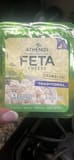
Feta Cheese
Ingredients
- Powdered cellulose minus 2.5 points
- Natamycin minus 2.5 points
Processing
- Processed (NOVA 3) minus 8 points
Nutrition per 100 g
- Saturated fat 3.5 g / 100 g minus 1.5 points
- Salt 0.8 g / 100 g minus 3 points
100 − 17.5 = 82.5 → 83
Nutrition per 100 g
| Energy | 70 kcal |
|---|---|
| Fat | 6 g |
| Saturated fat | 3.5 g |
| Trans fat | 0 g |
| Carbohydrates | 1 g |
| Sugars | 0 g |
| Added sugars | 0 g |
| Fiber | 1 g |
| Protein | 5 g |
| Salt | 0.8 g |
Serving: 1 serving (28 g)
Ingredients
- Feta Cheese (pasteurized Part-skim Milk, Cheese Culture, Salt, Enzymes)
- Powdered Cellulose To Prevent Caking
- Natamycin (a Natural Mold Inhibitor)
Label text, as published
Feta Cheese (pasteurized Part-skim Milk, Cheese Culture, Salt, Enzymes), Powdered Cellulose To Prevent Caking, Natamycin (a Natural Mold Inhibitor)
Allergens and diets
Contains: Milk
- Not vegan
- Palm-oil-free
Always check the package: recipes change.
More feta on GoodSwap
-
 Feta Crumbles President · 24 oz Ultra-processedHigh in saltHigh in saturated fat Score 67 out of 100 Good
 -
 Feta Crumbles President · 6 oz Ultra-processed Score 75 out of 100 Good
 -
 Crumbled Feta Cheese Original Emporium Selection · 4 oz High in saltHigh in saturated fat Score 79 out of 100 Good
 -
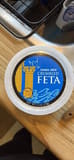 Crumbled Feta Trader Joe's · 6 oz High in saltHigh in saturated fat Score 79 out of 100 Good
 -
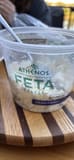 Feta Cheese Athknos · 12 oz Ultra-processed Score 73 out of 100 Good
 -
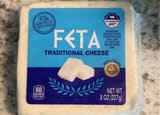 Traditional Feta Cheese Aldi · 8 oz High in saltHigh in saturated fat Score 79 out of 100 Good
More from Athenos
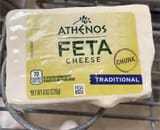
Sources
-
11. List of Permitted Preservatives (Lists of Permitted Food Additives)
“B.2 Butylated Hydroxyanisole n/a (a) Active dry yeasts (a) Preservative (a) 1,000 ppm n/a”
canada.ca
-
Saturated fatty acid and trans-fatty acid intake for adults and children: WHO guideline
“WHO recommends that adults and children reduce saturated fatty acid intake to 10% of total energy intake (strong recommendation).”
who.int
-
“For adults, WHO recommends less than 2000 mg/day of sodium (equivalent to less than 5 g/day salt), or just under a teaspoon.”
who.int