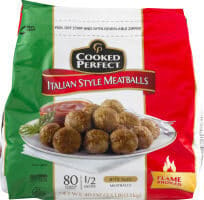
Frozen meats
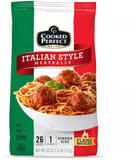
Cooked Perfect Italian Style Meatballs
85 g
Score
- Ultra-processed
- High in saturated fat
Why it scores 73
Cooked Perfect Italian Style Meatballs scores 73 out of 100 (Good) under GoodSwap’s published rules. What moved the score most:
- minus 18 points Ultra-processed (NOVA 4): Classified NOVA 4: made with industrial ingredients and additives. Strong
- minus 5 points Salt 1.5 g / 100 g: High in salt. Strong
- minus 3.5 points Saturated fat 7 g / 100 g: High in saturated fat. Counted at half for this whole-food category. Strong
Every line of the math is on The Receipt below, with its evidence tier and sources.
Better meatballs
-
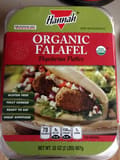 Organic Falafel Hannah Not ultra-processed · Less saturated fat Score 100 out of 100 , 27 points higher
 -
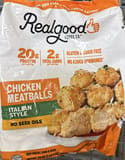 Chicken Meatballs Italian Style Realgood Foods Co. · 20 oz Not ultra-processed · Less saturated fat Score 93 out of 100 , 20 points higher
 -
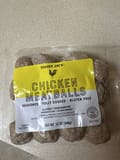 Chicken Meatballs Trader Joe's · 12 oz Not ultra-processed · Less saturated fat Score 91 out of 100 , 18 points higher
 -
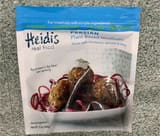 Persian Plant Based Meatballs Heidis Real Food · 12 oz Not ultra-processed · Less saturated fat Score 94 out of 100 , 21 points higher
 -
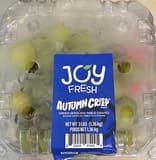 Green Seedless Grapes Joy · 126 g Not ultra-processed · Less saturated fat Score 93 out of 100 , 20 points higher
The same kind of product, at least 10 points higher, sold in the US. Never paid placements.
The Receipt
Italian Style Meatballs
Ingredients
- Soy protein isolate / concentrate minus 2.5 points
Processing
- Ultra-processed (NOVA 4) minus 18 points
Nutrition per 100 g
- Saturated fat 7 g / 100 g minus 3.5 points
- Salt 1.5 g / 100 g minus 5 points
- Energy 282 kcal / 100 g minus 0.5 points
- Protein 14 g / 100 g plus 2 points
100 − 27.5 = 72.5 → 73
Can’t score above 79. High in fat and saturated fat (above the front-of-pack "high" level). [5]
Nutrition per 100 g
| Energy | 282 kcal |
|---|---|
| Fat | 18 g |
| Saturated fat | 7 g |
| Trans fat | 0 g |
| Carbohydrates | 6 g |
| Sugars | 1 g |
| Added sugars | 0 g |
| Fiber | 2 g |
| Protein | 14 g |
| Salt | 1.5 g |
Serving: 6 meatball (85 g)
Ingredients
- BEEF AND PORK
- WATER
- TEXTURED SOY FLOUR
- BREAD CRUMBS (WHEAT FLOUR, SALT, YEAST)
- SOY PROTEIN CONCENTRATE
- SEASONING (PARMESAN CHEESE, SPICES (VARIOUS), SPICE EXTRACTIVES ON A DEXTROSE CARRIER, DEHYDRATED)
Label text, as published
BEEF AND PORK, WATER, TEXTURED SOY FLOUR, BREAD CRUMBS (WHEAT FLOUR, SALT, AND YEAST), SOY PROTEIN CONCENTRATE, SEASONING (PARMESAN CHEESE (PART SKIM COW'S MILK, CHEESE CULTURES, SALT, ENZYMES), SPICES (VARIOUS), SPICE EXTRACTIVES ON A DEXTROSE CARRIER, DEHYDRATED
Allergens and diets
Contains: Milk, Soy, Wheat, Gluten
- Not vegan
- Not vegetarian
- Not gluten-free
- Palm-oil-free
Always check the package: recipes change.
More frozen meats on GoodSwap
-
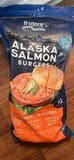 Alaska Salmon Burgers Trident Seafoods Ultra-processedContains seed oilsNo synthetic dyes Score 75 out of 100 Good
 -
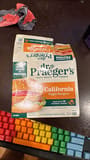 California Veggie Burgers Dr. Praeger's · 10 oz/283 g Contains seed oilsNo additivesContains whole grains Score 93 out of 100 Excellent
 -
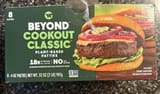 Cookout Classic Plant-Based Patties Beyond · 32 oz Ultra-processedHigh in saturated fatNo synthetic dyes Score 73 out of 100 Good
 -
 Fully Cooked Grilled Chicken Patty Don Lee Farms · 42 oz Contains added sugarsNo additives Score 76 out of 100 Good
 -
 Chicken & Maple Breakfast Sausage Applegate Naturals · 20 oz/1.25 lb/567 g Ultra-processedHigh in saltContains added sugarsNo additives Score 32 out of 100 Poor
 -
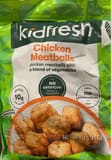 Chicken Meatballs Kidfresh · 16.45 oz Contains added sugarsContains seed oilsContains whole grains Score 63 out of 100 Good
More from Cooked Perfect
Sources
-
Saturated fatty acid and trans-fatty acid intake for adults and children: WHO guideline
“WHO recommends that adults and children reduce saturated fatty acid intake to 10% of total energy intake (strong recommendation).”
who.int
-
“For adults, WHO recommends less than 2000 mg/day of sodium (equivalent to less than 5 g/day salt), or just under a teaspoon.”
who.int
-
Dietary Guidelines for Americans, 2025–2030
“Limit foods and beverages that include artificial flavors, petroleum-based dyes, artificial preservatives, and low-calorie non-nutritive sweeteners.”
cdn.realfood.gov
-
“Table 3: Criteria for drinks (per 100ml)”
assets.publishing.service.gov.uk
-
“Greater exposure to ultra-processed food was associated with a higher risk of adverse health outcomes, especially cardiometabolic, common mental disorder, and mortality outcomes.”
doi.org