Food
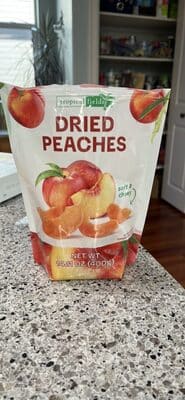
Tropical Fields Dried Peaches
Score
- High in sugar
- Contains added sugars
Why it scores 57
Tropical Fields Dried Peaches scores 57 out of 100 (Okay) under GoodSwap’s published rules. What moved the score most:
- minus 20 points Sugar: An added sugar. Strong
- minus 14 points Sugars 69.2 g / 100 g: Very high in sugar. Strong
- minus 7.5 points Sodium metabisulfite: Sulfites must be declared above 10 mg/kg in the EU and UK and at 10 ppm or more in the US because some people, especially people with asthma, react to them. Regulatory
Every line of the math is on The Receipt below, with its evidence tier and sources.
The Receipt
Dried Peaches
Ingredients
- Sugar minus 20 points
- Sodium metabisulfite minus 7.5 points
Nutrition per 100 g
- Sugars 69.2 g / 100 g minus 14 points
- Salt 0.8 g / 100 g minus 3 points
- Energy 308 kcal / 100 g minus 1 points
- Fiber 5.1 g / 100 g plus 2 points
100 − 43.5 = 56.5 → 57
Can’t score above 79. Contains sugar, an ingredient of high concern. [1][2][3]
Can’t score above 79. High in sugars (above the front-of-pack "high" level). [8]
Nutrition per 100 g
| Energy | 308 kcal |
|---|---|
| Fat | 0 g |
| Saturated fat | 0 g |
| Trans fat | 0 g |
| Carbohydrates | 76.9 g |
| Sugars | 69.2 g |
| Added sugars | 19.7 g |
| Fiber | 5.1 g |
| Protein | 2.6 g |
| Salt | 0.8 g |
Serving: 6 pieces (39 g)
Ingredients
- Peaches
- Sugar (high concern)
- Citric Acid
- Peach Powder
- Sodium Metabisulfite (Preservative) (moderate concern)
Label text, as published
Peaches, Sugar, Citric Acid, Peach Powder, Sodium Metabisulfite (Preservative)
Allergens and diets
Contains: Sulphites
- Vegan
- Vegetarian
- Gluten-free
- Palm-oil-free
Always check the package: recipes change.
More from Tropical Fields
Sources
-
Guideline: sugars intake for adults and children
“In both adults and children, WHO recommends reducing the intake of free sugars to less than 10% of total energy intake”
who.int
-
Dietary Guidelines for Americans, 2025–2030
“Limit foods and beverages that include artificial flavors, petroleum-based dyes, artificial preservatives, and low-calorie non-nutritive sweeteners.”
cdn.realfood.gov
-
Added and free sugars should be as low as possible
“Sugar consumption is a known cause of dental caries.”
efsa.europa.eu
-
Regulation (EU) No 1169/2011 of 25 October 2011 on the provision of food information to consumers
“ANNEX II SUBSTANCES OR PRODUCTS CAUSING ALLERGIES OR INTOLERANCES 1. Cereals containing gluten, namely: wheat, rye, barley, oats, spelt, kamut or their hybridised strains”
eur-lex.europa.eu
-
“1. Cereals containing gluten, namely: wheat (such as spelt and khorasan wheat), rye, barley, oats or their hybridised strains, and products thereof”
legislation.gov.uk
-
“For adults, WHO recommends less than 2000 mg/day of sodium (equivalent to less than 5 g/day salt), or just under a teaspoon.”
who.int
-
“Table 3: Criteria for drinks (per 100ml)”
assets.publishing.service.gov.uk