Chickens
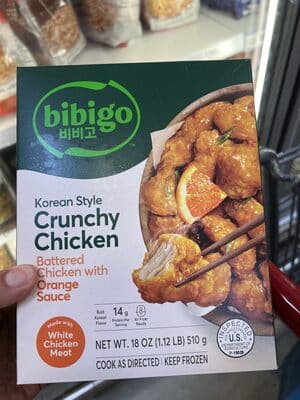
Bibigo Korean Style Crunchy Battered Chicken with Orange Sauce, Korean Style with Orange Sauce
18 oz
Score
- Contains added sugars
- Contains seed oils
Why it scores 36
Bibigo Korean Style Crunchy Battered Chicken with Orange Sauce, Korean Style with Orange Sauce scores 36 out of 100 (Poor) under GoodSwap’s published rules. What moved the score most:
- minus 20 points Sugar: An added sugar. Strong
- minus 18 points Ultra-processed (NOVA 4, estimated): No NOVA group on file; estimated from 6 kinds of ultra-processing markers. Strong
- minus 7.5 points 6 kinds of ultra-processing markers: Industrial additive classes found: emulsifier, flavor enhancer, flavoring, industrial protein, modified starch and thickener, stabilizer or gelling agent. Emerging
Every line of the math is on The Receipt below, with its evidence tier and sources.
The Receipt
Korean Style Crunchy Battered Chicken with Orange Sauce, Korean Style with Orange Sauce
Ingredients
- Sugar minus 20 points
- Modified starch minus 2.5 points
- Soybean oil minus 2.5 points
- Soy protein isolate / concentrate minus 1.5 points
- Lecithin minus 1.5 points
- Canola oil minus 1.5 points
- Wine minus 0.5 points
- Yeast extract minus 0.5 points
- Xanthan gum minus 0.5 points
- Natural flavors minus 0.5 points
Processing
- Ultra-processed (NOVA 4, estimated) minus 18 points
- 6 kinds of ultra-processing markers minus 7.5 points
Nutrition per 100 g
- Sugars 12.8 g / 100 g minus 5 points
- Saturated fat 1.3 g / 100 g minus 0.5 points
- Salt 0.9 g / 100 g minus 3 points
- Energy 205 kcal / 100 g minus 0.5 points
- Protein 10.3 g / 100 g plus 2 points
100 − 64 = 36
Can’t score above 79. Contains sugar, an ingredient of high concern. [1][2][3]
Nutrition per 100 g
| Energy | 205 kcal |
|---|---|
| Fat | 7.7 g |
| Saturated fat | 1.3 g |
| Trans fat | 0 g |
| Carbohydrates | 25.6 g |
| Sugars | 12.8 g |
| Added sugars | 12.8 g |
| Fiber | 0 g |
| Protein | 10.3 g |
| Salt | 0.9 g |
Serving: 1 cup of chicken and sauce (156 g)
Ingredients
- CRUNCHY CHICKEN (WHITE CHICKEN MEAT, DARK CHICKEN MEAT, WATER, WHEAT FLOUR, CORN STARCH, MODIFIED TAPIOCA STARCH, CORN MEAL, SALT, SUGAR, SOYBEAN OIL, SOY PROTEIN CONCENTRATE, SEASONING, SEASONING, SOY SAUCE, WHITE WINE VINEGAR, SODIUM BICARBONATE, GARLIC POWDER, BLACK PEPPER, EGG, ONION POWDER, GINGER POWDER, ROSEMARY POWDER. FRIED IN VEGETABLE OIL)
- SAUCE (WATER, SUGAR, DISTILLED WHITE VINEGAR, ORANGE JUICE CONCENTRATE, MODIFIED TAPIOCA STARCH, SOY SAUCE, SPICES, SALT, XANTHAN GUM, SEASONING, NATURAL FLAVORS, GARLIC PUREE) (not recognized)
Label text, as published
CRUNCHY CHICKEN (WHITE CHICKEN MEAT, DARK CHICKEN MEAT, WATER, WHEAT FLOUR, CORN STARCH, LESS THAN 2% OF MODIFIED TAPIOCA STARCH, CORN MEAL, SALT, SUGAR, SOYBEAN OIL, SOY PROTEIN CONCENTRATE [SOY PROTEIN CONCENTRATE, LECITHIN], SEASONING [BAKERS YEAST EXTRACT, SALT, CANOLA OIL], SEASONING [SAKE {WATER, RICE, KOJI [ASPERGILLUS ORYZAE]}, SUGAR, WATER, SALT, YEAST EXTRACT], SOY SAUCE [WATER, SOYBEANS, WHEAT, SALT], WHITE WINE VINEGAR, SODIUM BICARBONATE, GARLIC POWDER, BLACK PEPPER, EGG, ONION POWDER, GINGER POWDER, ROSEMARY POWDER. FRIED IN VEGETABLE OIL). SAUCE (WATER, SUGAR, DISTILLED WHITE VINEGAR, ORANGE JUICE CONCENTRATE, MODIFIED TAPIOCA STARCH, SOY SAUCE [WATER, SOYBEANS, WHEAT, SALT], LESS THAN 2% OF SPICES, SALT, XANTHAN GUM, SEASONING [BAKERS YEAST EXTRACT, SALT, CANOLA OIL], NATURAL FLAVORS, GARLIC PUREE [GARLIC, WATER]).
Allergens and diets
Contains: Soy, Wheat, Egg
- Not vegan
- Not vegetarian
- Not gluten-free
- Palm-oil-free
Always check the package: recipes change.
More chickens on GoodSwap
-
 Seasoned Rotisserie Chicken Kirkland Signature · 1360 g (1 chicken) Ultra-processedContains added sugarsContains emulsifiers studied for gut effects Score 26 out of 100 Poor
 -
 Mandarin Orange Chicken Crazy Cuizine · 66 oz Ultra-processedContains added sugarsContains emulsifiers studied for gut effectsContains seed oils Score 20 out of 100 Poor
 -
 Chicken Meatballs Trader Joe's · 12 oz Score 91 out of 100 Excellent
 -
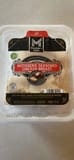 Rotisserie Seasoned Chicken Breast Member's Mark · 22 oz Ultra-processedHigh in saltContains added sugarsNo synthetic dyes Score 51 out of 100 Okay
 -
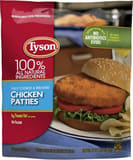 All natural frozen chicken breast patties Tyson · 26 oz Ultra-processedContains added sugarsNo synthetic dyesContains whole grains Score 53 out of 100 Okay
 -
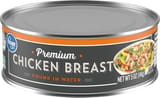 Premium Chicken Breast Chunk in Water Kroger · 142 g Ultra-processed Score 78 out of 100 Good
More from Bibigo
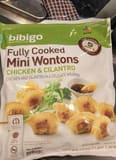
Sources
-
Guideline: sugars intake for adults and children
“In both adults and children, WHO recommends reducing the intake of free sugars to less than 10% of total energy intake”
who.int
-
Dietary Guidelines for Americans, 2025–2030
“Limit foods and beverages that include artificial flavors, petroleum-based dyes, artificial preservatives, and low-calorie non-nutritive sweeteners.”
cdn.realfood.gov
-
Added and free sugars should be as low as possible
“Sugar consumption is a known cause of dental caries.”
efsa.europa.eu
-
“replacement of saturated fat in the diet with linoleic acid effectively lowers serum cholesterol but does not support the hypothesis that this translates to a lower risk of death from coronary heart disease or all causes.”
doi.org
-
“These data provide support for current recommendations to replace saturated fat with polyunsaturated fat for primary prevention of CHD.”
doi.org
-
About Alcohol Use During Pregnancy
“There is no known safe amount of alcohol use during pregnancy.”
cdc.gov
-
Agents Classified by the IARC Monographs, Volumes 1–142 (List of Classifications)
monographs.iarc.who.int
-
21 CFR 101.22 Foods; labeling of spices, flavorings, colorings and chemical preservatives
“whose significant function in food is flavoring rather than nutritional.”
ecfr.gov
-
Saturated fatty acid and trans-fatty acid intake for adults and children: WHO guideline
“WHO recommends that adults and children reduce saturated fatty acid intake to 10% of total energy intake (strong recommendation).”
who.int
-
“For adults, WHO recommends less than 2000 mg/day of sodium (equivalent to less than 5 g/day salt), or just under a teaspoon.”
who.int