Beauty & personal care
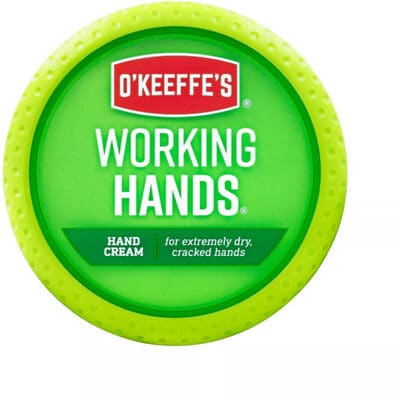
O’Keeffe’s Working Hands Hand Cream
2.7 oz
Score
- Contains a formaldehyde-releasing preservative
- May contain traces of 1,4-dioxane
Why it scores 86
O’Keeffe’s Working Hands Hand Cream scores 86 out of 100 (Excellent) under GoodSwap’s published rules. What moved the score most:
- minus 12 points Diazolidinyl urea: Releases formaldehyde; in the EU products must state "releases formaldehyde" when total released formaldehyde exceeds 0.001% (10 ppm). Regulatory
- minus 1 points Mineral oil and petrolatum: The EU prohibits petrolatum and mineral oils unless the full refining history is known and the source is not a carcinogen. Regulatory
- minus 1 points Iodopropynyl butylcarbamate (IPBC): The EU allows it up to 0.02% in rinse-off and 0.01% in leave-on products, and not in most products for children under 3 (Annex V). Regulatory
Every line of the math is on The Receipt below, with its evidence tier and sources.
Better lotions and moisturizers
-
 Lanolin Nipple Cream Lansinoh · 7 g No formaldehyde releasers · No ethoxylated ingredients Score 100 out of 100 , 14 points higher
 -
 Daily Moisturizing Cream Aveeno No formaldehyde releasers · No ethoxylated ingredients Score 100 out of 100 , 14 points higher
 -
 Aveeno skin relief hand cream No formaldehyde releasers · No ethoxylated ingredients Score 97 out of 100 , 11 points higher
 -
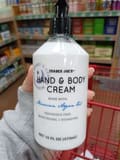 Hand and Body Cream Trader Joe's · 473 mL No formaldehyde releasers · No ethoxylated ingredients Score 96 out of 100 , 10 points higher
 -
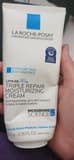 lipkar Ap + Max triple repair moisturizing cream La Roche-Posay · 200 mL No formaldehyde releasers · No diazolidinyl urea Score 98 out of 100 , 12 points higher
The same kind of product, at least 10 points higher, sold in the US. Never paid placements.
The Receipt
Working Hands Hand Cream
Ingredients
- Diazolidinyl urea minus 12 points
- Mineral oil and petrolatum minus 1 points
- Iodopropynyl butylcarbamate (IPBC) minus 1 points
- Polysorbates (cosmetic) minus 0.5 points
100 − 14.5 = 85.5 → 86
Ingredients
- Water
- Glycerin
- Stearic Acid
- Sodium Hydroxide
- Paraffin
- Hydroxypropyl Methylcellulose
- Allantoin
- Octyldodecyl Stearate
- Diazolidinyl Urea (high concern)
- Iodopropynyl Butylcarbamate
- Acrylates/Acrylamide Copolymer
- Mineral Oil
- Polysorbate 85
Label text, as published
Water, Glycerin, Stearic Acid, Sodium Hydroxide, Paraffin, Hydroxypropyl Methylcellulose, Allantoin, Octyldodecyl Stearate, Diazolidinyl Urea, Iodopropynyl Butylcarbamate, Acrylates/Acrylamide Copolymer, Mineral Oil, Polysorbate 85
Allergens and diets
- Palm-oil-free
Always check the package: recipes change.
Sources
-
“shall be labelled with the warning “releases formaldehyde” where the total concentration of formaldehyde released in the finished product exceeds 0,001 % (10 ppm)”
eur-lex.europa.eu
-
Revised Code of Washington, Chapter 70A.560 (Toxic-Free Cosmetics Act)
“(a) Ortho-phthalates; (b) Perfluoroalkyl and polyfluoroalkyl substances; (c) Formaldehyde (CAS 50-00-0) and chemicals determined by the department to release formaldehyde;”
app.leg.wa.gov
-
Regulation (EC) No 1223/2009 of 30 November 2009 on cosmetic products
“cosmetic products shall not contain any of the following: (a) prohibited substances — prohibited substances listed in Annex II”
eur-lex.europa.eu
-
1,4-Dioxane in Cosmetics: A Manufacturing Byproduct
“1,4-dioxane forms as a byproduct during the manufacturing process of certain cosmetic ingredients.”
fda.gov
-
“Formaldehyde should also be added to the list of substances prohibited in cosmetic products in Annex II to Regulation (EC) No 1223/2009.”
eur-lex.europa.eu
-
Agents Classified by the IARC Monographs, Volumes 1–142 (List of Classifications)
monographs.iarc.who.int