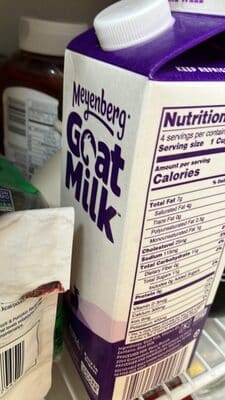
Goat milks
Meyenberg Goat Milk
Score
- No additives
Why it scores 100
Meyenberg Goat Milk scores 100 out of 100 (Excellent) under GoodSwap’s published rules. What moved the score most:
- minus 5 points Sugars 11 g / 100 g: High in sugar. Strong
- plus 5 points Simple whole food: A few low-concern ingredients, minimally processed. Info
- plus 3 points No additives: No food additives in the ingredient list. Info
Every line of the math is on The Receipt below, with its evidence tier and sources.
The Receipt
Goat Milk
Nutrition per 100 g
- Sugars 11 g / 100 g minus 5 points
- Saturated fat 4 g / 100 g minus 1.5 points
Bonuses
- Simple whole food plus 5 points
- No additives plus 3 points
100 + 1.5 = 101.5 → 100
Nutrition per 100 g
| Energy | 140 kcal |
|---|---|
| Fat | 7 g |
| Saturated fat | 4 g |
| Trans fat | 0 g |
| Carbohydrates | 11 g |
| Sugars | 11 g |
| Fiber | 0 g |
| Protein | 0 g |
| Salt | 0.3 g |
Serving: 1 cup (240 ml)
Ingredients
Label text, as published
Ingredients Ingredients: Goat Milk, Vitamin D3.Contains: Goat Milk
Allergens and diets
Contains: Milk
- Not vegan
- Palm-oil-free
Always check the package: recipes change.
Sources
-
Guideline: sugars intake for adults and children
“In both adults and children, WHO recommends reducing the intake of free sugars to less than 10% of total energy intake”
who.int
-
Saturated fatty acid and trans-fatty acid intake for adults and children: WHO guideline
“WHO recommends that adults and children reduce saturated fatty acid intake to 10% of total energy intake (strong recommendation).”
who.int