Food
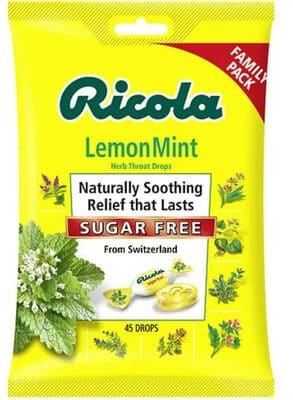
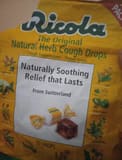
Ricola Lemon Mint Sugar Free Herb Throat Drops
45 ct
Score
- Ultra-processed
- Contains non-nutritive sweeteners
- Contains sugar alcohols
- No synthetic dyes
Why it scores 51
Ricola Lemon Mint Sugar Free Herb Throat Drops scores 51 out of 100 (Okay) under GoodSwap’s published rules. What moved the score most:
- minus 20 points Aspartame: Labels must warn people with phenylketonuria (PKU) because aspartame contains phenylalanine (US and EU). Regulatory
- minus 18 points Ultra-processed (NOVA 4): Classified NOVA 4: made with industrial ingredients and additives. Strong
- minus 4.5 points 4 kinds of ultra-processing markers: Industrial additive classes found: color (added), flavoring, non-nutritive sweetener and sugar alcohol (polyol). Emerging
Every line of the math is on The Receipt below, with its evidence tier and sources.
Better hard candy and mints
-
 Herb throat drops natural cherry-honey Ricola Not ultra-processed · No non-nutritive sweeteners Score 100 out of 100 , 49 points higher
 -
 Naturally Sugar Free Mints, Spearmint Zellies Inc. No non-nutritive sweeteners · No aspartame Score 73 out of 100 , 22 points higher
 -
 Super Free Mints Velamints · 0.7 oz/20 g Not ultra-processed · No non-nutritive sweeteners Score 73 out of 100 , 22 points higher
 -
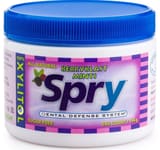 Sugar-free xylitol berryblast mints Spry No non-nutritive sweeteners · No aspartame Score 64 out of 100 , 13 points higher
 -
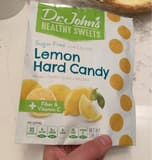 Lemon Hard Candy Dr. John's Healthy Sweets · 3.85 oz/109 g Not ultra-processed · No aspartame Score 64 out of 100 , 13 points higher
The same kind of product, at least 10 points higher, sold in the US. Never paid placements.
The Receipt
Lemon Mint Sugar Free Herb Throat Drops
Ingredients
- Aspartame minus 20 points
- Menthol (flavor) minus 2.5 points
- Isomalt minus 2.5 points
- Natural flavors minus 1.5 points
Processing
- Ultra-processed (NOVA 4) minus 18 points
- 4 kinds of ultra-processing markers minus 4.5 points
100 − 49 = 51
Can’t score above 79. Contains aspartame, an ingredient of high concern. [1][2][3][4][5][6][7][8][9]
Nutrition per 100 g
| Energy | 100 kcal |
|---|---|
| Fat | 0 g |
| Saturated fat | 0 g |
| Carbohydrates | 25 g |
| Sugars | 0 g |
| Added sugars | 0 g |
| Fiber | 0 g |
| Protein | 0 g |
| Salt | 0 g |
Ingredients
- drug facts active ingredient (in each drop) menthol
- 1.1 mg... purpose oral anesthetic uses temporarily relieves occasional minor irritation and pain associated with sore mouth (not recognized)
- sore throat warnings do not use (not recognized)
- in children under 6 years of age unless directed by a doctor. stop use and ask a doctor if (not recognized)
- sore throat is severe (not recognized)
- persists for more than 2 days (not recognized)
- or is accompanied by fever (not recognized)
- headache (not recognized)
- rash (not recognized)
- nausea or vomiting (not recognized)
- sore mouth symptoms do not improve in 7 days. keep out of reach of children. directions (not recognized)
- adults and children 6 years and older: dissolve 3 drops (one at a time) slowly in the mouth. do not bite or chew. repeat every 2 hours as needed or as directed by a doctor (not recognized)
- excessive use may have a laxative effect (not recognized)
- protect from heat and moisture (not recognized)
- product may be useful for diabetics on the advice of a doctor exchange information: 2 drops = free exchange 7 drops = 1 fruit dietary exchanges based on exchange lists for diabetes ©2008 american diabetes association (not recognized)
- american dietetic association. inactive ingredients ascorbic acid (vitamin c)
- aspartame (high concern)
- citric acid
- extracts of lemon balm and a ricola herb mixture (elder, horehound, hyssop, lemon balm, linden flowers, mallow, peppermint, sage, thyme, wild thyme)
- isomalt
- natural color (beta-carotene)
- natural flavors
Label text, as published
drug facts active ingredient (in each drop) menthol, 1.1 mg... purpose oral anesthetic uses temporarily relieves occasional minor irritation and pain associated with sore mouth • sore throat warnings do not use • in children under 6 years of age unless directed by a doctor. stop use and ask a doctor if • sore throat is severe, persists for more than 2 days, or is accompanied by fever, headache, rash, nausea or vomiting. • sore mouth symptoms do not improve in 7 days. keep out of reach of children. directions • adults and children 6 years and older: dissolve 3 drops (one at a time) slowly in the mouth. do not bite or chew. repeat every 2 hours as needed or as directed by a doctor • children under 6 years: ask a doctor other information phenylketonurics, contains phenylalanine 1 mg per drop. • excessive use may have a laxative effect • protect from heat and moisture • product may be useful for diabetics on the advice of a doctor exchange information: 2 drops = free exchange 7 drops = 1 fruit dietary exchanges based on exchange lists for diabetes ©2008 american diabetes association, american dietetic association. inactive ingredients ascorbic acid (vitamin c), aspartame, citric acid, extracts of lemon balm and a ricola herb mixture (elder, horehound, hyssop, lemon balm, linden flowers, mallow, peppermint, sage, thyme, wild thyme), isomalt, natural color (beta-carotene), natural flavors
More from Ricola
Sources
-
Regulation (EU) No 1169/2011, Annex III point 2.3 (aspartame)
“‘contains a source of phenylalanine’ shall appear on the label in cases where aspartame/aspartame-acesulfame salt is designated in the list of ingredients by its specific name.”
eur-lex.europa.eu
-
Aspartame hazard and risk assessment results released (IARC, WHO and FAO joint news release)
“Citing “limited evidence” for carcinogenicity in humans, IARC classified aspartame as possibly carcinogenic to humans (IARC Group 2B) and JECFA reaffirmed the acceptable daily intake of 40 mg/kg body weight.”
who.int
-
Aspartame and Other Sweeteners in Food
“The FDA disagrees with IARC’s conclusion that these studies support classifying aspartame as a possible carcinogen to humans.”
fda.gov
-
“Aspartame and its breakdown products are safe for human consumption at current levels of exposure”
efsa.europa.eu
-
Artificial sweeteners and cancer risk: Results from the NutriNet-Santé population-based cohort study
“In this large cohort study, artificial sweeteners (especially aspartame and acesulfame-K), which are used in many food and beverage brands worldwide, were associated with increased cancer risk.”
doi.org
-
WHO advises not to use non-sugar sweeteners for weight control in newly released guideline
“The recommendation is based on the findings of a systematic review of the available evidence which suggests that use of NSS does not confer any long-term benefit in reducing body fat in adults or children.”
who.int
-
Dietary Guidelines for Americans, 2025–2030
“Limit foods and beverages that include artificial flavors, petroleum-based dyes, artificial preservatives, and low-calorie non-nutritive sweeteners.”
cdn.realfood.gov
-
Regulation (EU) No 1169/2011, Annex III point 2.4 (foods with more than 10 % added polyols)
“‘excessive consumption may produce laxative effects’.”
eur-lex.europa.eu
-
21 CFR 101.22 Foods; labeling of spices, flavorings, colorings and chemical preservatives
“whose significant function in food is flavoring rather than nutritional.”
ecfr.gov
-
“Greater exposure to ultra-processed food was associated with a higher risk of adverse health outcomes, especially cardiometabolic, common mental disorder, and mortality outcomes.”
doi.org