Frozen foods
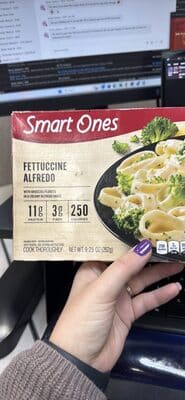
Smart Ones Fettuccine Alfredo
9.25 oz
Score
- Ultra-processed
- Contains emulsifiers studied for gut effects
Why it scores 70
Smart Ones Fettuccine Alfredo scores 70 out of 100 (Good) under GoodSwap’s published rules. What moved the score most:
- minus 18 points Ultra-processed (NOVA 4): Classified NOVA 4: made with industrial ingredients and additives. Strong
- minus 7.5 points Carrageenan: In the NutriNet-Santé cohort, higher carrageenan intake was associated with a higher risk of type 2 diabetes; cause and effect is not established. Strong
- minus 2.5 points Whey protein concentrate / isolate: An ingredient typical of ultra-processed foods (NOVA group 4). Info
Every line of the math is on The Receipt below, with its evidence tier and sources.
Better frozen meals
-
 100% Vegetable Pasta, Fettuccine Alfredo Birds Eye · 10 oz/284 g Not ultra-processed · No gut-studied emulsifiers Score 90 out of 100 , 20 points higher
 -
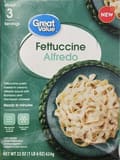 Fettuccine Alfredo Great Value · 22 oz Not ultra-processed · No gut-studied emulsifiers Score 94 out of 100 , 24 points higher
 -
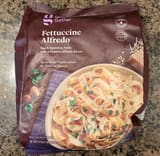 Fettuccine Alfredo Good & Gather · 22 oz Not ultra-processed · No gut-studied emulsifiers Score 94 out of 100 , 24 points higher
 -
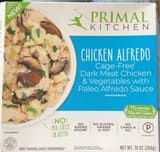 Chicken Alfredo Primal Kitchen · 10 oz Not ultra-processed · No gut-studied emulsifiers Score 99 out of 100 , 29 points higher
 -
 Chicken fettuccine alfredo Great Value · 10 oz/283 g Not ultra-processed · No gut-studied emulsifiers Score 92 out of 100 , 22 points higher
The same kind of product, at least 10 points higher, sold in the US. Never paid placements.
The Receipt
Fettuccine Alfredo
Ingredients
- Carrageenan minus 7.5 points
- Whey protein concentrate / isolate minus 2.5 points
Processing
- Ultra-processed (NOVA 4) minus 18 points
- 2 kinds of ultra-processing markers minus 1.5 points
Nutrition per 100 g
- Salt 0.4 g / 100 g minus 1 points
100 − 30.5 = 69.5 → 70
Nutrition per 100 g
| Energy | 95 kcal |
|---|---|
| Fat | 1.3 g |
| Saturated fat | 0.8 g |
| Trans fat | 0 g |
| Carbohydrates | 15.7 g |
| Sugars | 1.2 g |
| Added sugars | 0 g |
| Fiber | 1.1 g |
| Protein | 4.2 g |
| Salt | 0.4 g |
Serving: 1 PACKAGE (262 g)
Ingredients
- COOKED ENRICHED MACARONI PRODUCT (WATER, ENRICHED SEMOLINA, CARRAGEENAN)
- SAUCE (WATER, HALF AND HALF, PARMESAN CHEESE, CORNSTARCH, WHEY PROTEIN CONCENTRATE, NONFAT MILK, ROMANO CHEESE MADE FROM COW'S MILK, CHEESE PASTE, SALT, GRANULATED GARLIC, SPICE) (not recognized)
- BROCCOLI
Label text, as published
COOKED ENRICHED MACARONI PRODUCT (WATER, ENRICHED SEMOLINA [DURUM WHEAT FLOUR, NIACIN, FERROUS SULFATE, THIAMINE MONONITRATE, RIBOFLAVIN, FOLIC ACID], CARRAGEENAN), SAUCE (WATER, HALF AND HALF [MILK, CREAM], PARMESAN CHEESE [CULTURED PART-SKIM MILK, SALT, ENZYMES], CORNSTARCH, WHEY PROTEIN CONCENTRATE, NONFAT MILK, ROMANO CHEESE MADE FROM COW'S MILK [CULTURED PART SKIMMED COW'S MILK, SALT, ENZYMES], CHEESE PASTE [PARMESAN AND CHEDDAR CHEESE (PASTURIZED MILK, CHEESE CULTURES, SALT, ENZYMES), WATER, SALT], SALT, GRANULATED GARLIC, SPICE), BROCCOLI
Allergens and diets
Contains: Milk, Wheat, Gluten
- Not vegan
- Not gluten-free
- Palm-oil-free
Always check the package: recipes change.
More frozen foods on GoodSwap
-
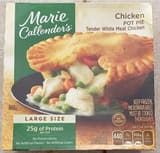 Chicken Pot Pie Tender White Meat Chicken Marie Callender's · 425 g Ultra-processedHigh in saturated fatContains added sugarsContains emulsifiers studied for gut effects Score 15 out of 100 Bad
 -
 Bowls Broccoli & Cheddar Bake Amy's · 269 g Ultra-processedContains added sugarsContains seed oilsNo synthetic dyes Score 48 out of 100 Okay
 -
 Spinach Egg White Frittata Veggies Made Great · 12 oz Ultra-processedContains added sugarsContains seed oilsContains whole grains Score 48 out of 100 Okay
 -
 Chicken Enchilada Suiza Lean Cuisine · 9 oz Ultra-processedContains added sugarsContains emulsifiers studied for gut effectsContains seed oils Score 37 out of 100 Poor
 -
 Vegetable Fried Rice Innovasian · 18 oz Ultra-processedContains added sugarsContains seed oilsNo synthetic dyes Score 50 out of 100 Okay
 -
 Croissant Sausage, Cage Free* Egg & Cheese Sandwich Jimmy Dean · 54 oz Ultra-processedHigh in saturated fatContains added sugarsContains emulsifiers studied for gut effects Score 15 out of 100 Bad
More from Smart Ones


Sources
-
“We found direct associations between the risk of type 2 diabetes and exposures to various food additive emulsifiers widely used in industrial foods, in a large prospective cohort of French adults.”
doi.org
-
Dietary emulsifiers impact the mouse gut microbiota promoting colitis and metabolic syndrome
“carboxymethylcellulose and polysorbate-80, induced low-grade inflammation and obesity/metabolic syndrome in wild-type hosts and promoted robust colitis in mice predisposed to this disorder.”
doi.org
-
Re-evaluation of carrageenan (E 407) and processed Eucheuma seaweed (E 407a) as food additives
“However, the Panel noted uncertainties as regards the chemistry, the exposure assessment and biological and toxicological data.”
doi.org
-
Agents Classified by the IARC Monographs, Volumes 1–142 (List of Classifications)
monographs.iarc.who.int
-
“For adults, WHO recommends less than 2000 mg/day of sodium (equivalent to less than 5 g/day salt), or just under a teaspoon.”
who.int
-
“Greater exposure to ultra-processed food was associated with a higher risk of adverse health outcomes, especially cardiometabolic, common mental disorder, and mortality outcomes.”
doi.org
-
“Relative to control subjects, CMC consumption modestly increased postprandial abdominal discomfort and perturbed gut microbiota composition in a way that reduced its diversity.”
doi.org
-
“This study found positive associations between risk of CVD and intake of five individual and two groups of food additive emulsifiers widely used in industrial foods.”
doi.org